


Most early-career scientists can describe their research in detail, but stumble when asked who they are beyond their research. Isabelle Kohler makes the case for building a personal profile – and breaks down the three aspects that shape it: your life mission, your drives, and your competencies.
It’s not a secret to anyone: the large majority of PhD graduates will find a job outside of academia – whether at a company, a start-up, the government, or a non-profit. Although I’ve seen encouraging initiatives from career services at Dutch universities, PhD students and postdocs still lack sufficient support when it comes to preparing their next career step – especially outside of academia.
This often results in a familiar situation: PhD students are well aware of their technical skills, but struggle to see what other skills they have built along the way, let alone how to communicate those to a recruiter or hiring manager. After all, they’ve typically spent their entire career in academia – first studying, then doing a PhD, then maybe a postdoc – and very few have had the chance to see how that other world works.
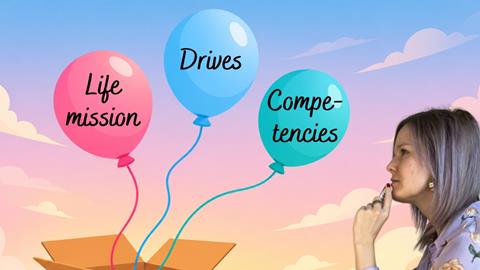
One of the first steps any PhD student can take – and this applies regardless of where you are in your PhD, or even if you’re a Master’s student or anyone else considering a career move – is to build your personal profile. A personal profile is composed of three aspects: your life mission, your drives, and your competencies.
Life mission
Your life mission is the overarching purpose that gives direction to your life – the ’why’ behind what you do. Because it’s tied to lived experience and evolves as you grow, it’s rarely a fixed statement. Many people can only articulate it in retrospect, after noticing patterns in what has consistently felt meaningful to them. For me, my life mission is to help people by sharing my knowledge.
Drives
Your drives are your intrinsic motivators – the things that energize you from the inside, independently of any external reward. Where your life mission is about purpose and direction, your drives are about energy and pull. A useful way to find them is to ask yourself: what would I do even if no one was watching? What kinds of activities make me lose track of time?
Competencies
The last aspect, competencies, is often the most unclear for early-career scientists. Competencies are recognizable patterns of behavior that show up consistently over time and across different circumstances – not something you did once, but something that characterizes how you tend to act. A competency is made up of three layers: your knowledge and experience, your hard and soft skills, and your qualities. Hard skills are technical and specific; soft skills are transferable and interpersonal. Qualities are stable personal characteristics – things like perseverance, curiosity, or empathy – and are often the hardest to see in yourself because they feel like ’just who you are’. Together, these three layers give a much richer picture of who you are professionally than skills alone ever could.
How to get started
A practical method is to use storytelling. Pick one experience from your career so far – a project you’re proud of, a moment where something clicked, or a difficult situation that taught you something. Describe what happened, what you did, and how it turned out. Then ask yourself: what did you find yourself caring about most? What came naturally to you? The answers will start to point you toward your life mission, your drives, and your competencies – not as abstract concepts, but as patterns already there, waiting to be named. Once you’ve done this for one experience, repeat the exercise with others.
Building a personal profile won’t happen in an afternoon – but starting early can bring a lot of clarity. The PhD student who can walk a recruiter through a total synthesis or explain the logic behind their spectroscopic analysis, and who can also articulate what drives them and what they’re genuinely good at beyond the bench – that person stands in a very different position when the time comes. You already have more to say about yourself than you think. This is how you start finding the words.
If you are interested in learning more about how to navigate academia and get to your professional self better, do not hesitate to join the NextMinds Community! For this, you have plenty of choices: visit NextMinds website to learn more about my work, sign up for the newsletter, and follow me and NextMinds on LinkedIn.











Nog geen opmerkingen