


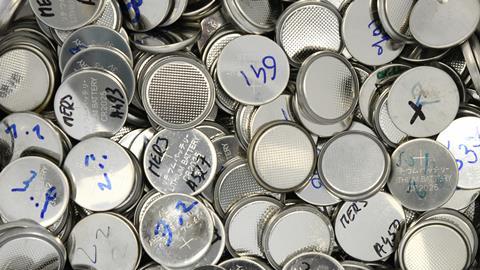
The ultimate battery is sustainable, affordable, recyclable, and contains as few critical materials as possible. And, ideally, it should be manufactured in Europe. Researchers have their work cut out. ‘In principle, there are countless elements in the periodic table that can be used to make a battery.’
About twenty years ago, the battery industry decided to fully commit to a technology that held great promise at the time: the lithium-ion battery. Today, this battery has become the standard for electronics and electric vehicles. As the lightest element that is a solid, lithium is the perfect choice for a battery designed for mobility—lightweight and with high energy density. Yet the technology has its shortcomings. For instance, these batteries can catch fire and explode if they overheat, and there are still hardly any ways to recycle them in an environmentally friendly manner.
Additionally, Asia, particularly China, dominates the vast majority of the market and the materials related to lithium-ion technology. Furthermore, the extraction of the necessary critical materials causes significant environmental damage, and working conditions are, in some cases, inhumane. More than enough reason to seek out better materials and technological innovations for the sustainable battery of the future. But what will that battery look like?
Next step: sodium
A challenger has emerged to dethrone the lithium-ion battery: the sodium-ion battery. Its key raw material—sodium derived from salt—is widely available, easier to recycle, and results in lower production costs and improved safety. Physical chemist Moniek Tromp, a professor at the University of Groningen, is the figurehead of the National Growth Fund project “Material Independence & Circular Batteries,” a collaboration between more than 60 companies and research institutions aimed at strengthening the Netherlands’ position in the global battery supply chain. Tromp: ‘The sodium-ion battery is the next step we are all now focusing on within this project at the national level.’
A major advantage of sodium-ion technology is that it is relatively comparable to that of lithium-ion batteries, Tromp explains. ‘You therefore don’t have to replace all your equipment or develop an entirely new factory. New innovations for this battery can be brought to market fairly quickly.’
In Asia, the first electric cars equipped with sodium-ion batteries have actually been rolling off the assembly line since last year. That doesn’t mean there isn’t still work to be done. Compared to lithium-ion batteries, sodium-ion batteries generally have a lower energy density, and some types also suffer from a shorter lifespan in terms of charge cycles. Tromp: ‘Sodium is a larger ion than lithium, which means the batteries require all kinds of optimizations. Think of modifying the cathode where the sodium moves in and out.’
‘Innovations in sodium-ion batteries can be brought to market relatively quickly’
Moniek Tromp, University of Groningen
Tromp and her colleagues are researching the sustainable optimization of various types of batteries, including sodium-ion and lithium-ion, but also, for example, iron-air batteries. For this purpose, she developed her own X-ray spectrometer, which allows researchers to characterize interactions between substrates and catalysts. ‘Using X-rays, we observe what is happening where during the charging and discharging of batteries. For example, we observed in commercial lithium-ion batteries that the cathode slowly dissolves depending on the charging cycles. Based on these kinds of results, we formulate optimizations to stop or accelerate processes, for example, using coatings or a different type of electrolyte or membrane.’
Reversibility
Although sodium-ion technology offers new opportunities for Europe, we shouldn’t assume that we can easily capture the market, says Marnix Wagemaker of Delft University of Technology —coordinator of the national research program BatteryNL and the SMART-CBAT Growth Fund program. ‘In China, they are much further ahead in terms of technology,’ says Wagemaker. ‘There, they are already commercializing the sodium-ion battery. It is up to Europe to search for new materials that surpass the performance of first-generation sodium-ion technology, thereby creating its own playing field.’
The major challenge is reversibility, says Wagemaker. ‘Your charge carrier —whether it’s lithium, sodium, or something else— must move back and forth between the anode and the cathode without getting stuck due to certain degradation processes. For a battery with a good lifespan, this efficiency needs to approach 99.9999%. That’s very difficult to achieve in electrochemical processes.’
Wagemaker therefore doesn’t envision a single battery of the future, but rather a whole range of innovations, each with its own advantages and disadvantages. ‘In principle, there are countless elements in the periodic table that can be used to make a battery,’ he explains. ‘I see it as a forest of chemical possibilities. Among those countless options, we’re searching for a sustainable path toward a battery that can be charged and discharged as many times as possible.’
‘It is up to Europe to seek out new materials and thereby carve out its own niche’
Marnix Wagemaker, Delft University of Technology
Charging efficiency
Wagemaker and his team study the charging efficiency of materials at the atomic level. To do this, they use neutrons from a nuclear reactor to observe ions migrating from the anode to the cathode and to identify where this process goes wrong. They then combine these results with quantum mechanical simulations and AI to predict optimizations. ‘With sodium-ion batteries, for example, one challenge is to develop a crystal structure for cathodes that combines sufficient sodium storage, fast charging times, and a long lifespan. Using physics-driven AI, we are searching for new materials for this cathode of the future.’
AI also plays a key role in the autonomous production of batteries at the European level. Materials chemist An Hardy, a professor at Hasselt University, is part of the European FULL-MAP project. This collaboration between 32 companies and research institutions, coordinated by the Vrije Universiteit Brussel, connects European laboratories and companies that are part of the value chain. Hardy: ‘We want to bring together the data collected from all these separate European locations and share it with one another. We hope this will allow us to take innovative steps much more quickly.’
Remote control
To automate this process, the researchers plan to use AI and robotics. ‘We intend to place robotics in labs at various institutions that can receive commands remotely,’ says Hardy. ‘This will allow us to utilize facilities in other laboratories. Consider, for example, the automated testing of a new material.’
‘By automating the process of developing a synthesis, we can save a significant amount of time’
An Hardy, Hasselt University
The researchers will then centrally manage these results and use them to further train the AI. Hardy and her research group are focusing on developing less toxic and sustainable materials for the battery of the future. ‘As materials chemists, we can use the AI, for example, to help predict the synthesis of a new material. Currently, working out such a synthesis takes a very long time due to the many possible routes, involving a lot of trial and error. By automating this, we can save a significant amount of time.’
In addition to developing sustainable materials, Tromp also sees the reproducibility of battery production as a major challenge. ‘This is a big problem both in the lab and in industry. Integrating all the innovations developed into a single battery—where all the connections must fit together and function properly—is a challenge that goes far beyond the mere structure of the materials.’ Wagemaker adds: ‘If, so to speak, you give researchers in China, America, and the Netherlands all the same materials to make a battery, you’ll see that the results still differ. It really comes down to the details.’
For that reason, Wagemaker actually sees an advantage for small countries like the Netherlands and Belgium. ‘Because we can share results with each other relatively easily, you quickly figure out where a problem lies. We really have an opportunity to standardize battery development at the national level and grow rapidly by learning from one another.’






Nog geen opmerkingen