
In March, NWO and the National Growth Fund’s Cellular Agriculture program awarded 4.1 million euros to three projects, two of which focus on cultured meat. We asked Joshua Flack and David Kilian, the principal investigators of these projects, what they plan to do to bring this animal-friendly meat to our plates.
Scaling up and reducing the costs of cultured meat production. That is what the two consortia of the Cellular Agriculture program will be working on. One consortium, UP-CELL, led by cell biologist Joshua Flack of Delft University of Technology, focuses on optimizing cell lines for industrial production. The other consortium, MeatUp, led by tissue engineer David Kilian of the MERLN Institute and Maastricht University, focuses on materials to convert muscle and fat tissue into fully-fledged cuts of meat with a realistic structure. We asked both researchers for their perspective on current cultured meat research.
Cell optimization
Joshua Flack “designs” cells suitable for the large-scale production of cultured meat. When cells are extracted from an animal, they lose much of their support systems. Gone are the physical interactions with the surrounding tissue. Because of this disruption, the crucial building blocks for cultured meat often fail to perform essential tasks, such as proliferation (rapid cell division) or differentiation (transforming into specialized cells). Flack: ’We’re trying to get harvested cow cells to do this again, only this time in a large steel bucket.’
’We want to move toward cells that can grow on a simpler and cheaper medium’
Joshua Flack, TU Delft
With his research group, Flack is working on improving cell lines, for example by genetically modifying or gene-editing them and selecting them before or during cultivation based on specific criteria like growth rate. In 2025, he received $2 million from the Bezos Earth Fund to use AI and machine learning to accelerate the identification of cells with promising properties under the microscope. With UP-CELL, he also aims to focus on creating cells that thrive in large-scale cultures. ’By analyzing both gene expression and the physical characteristics of cells, we aim to predict which cell lines are most suitable for cultivation.’
Different approaches
The ideal cultured meat cell must meet an extensive list of criteria. Among other things, it must be able to grow rapidly and have a long lifespan. ’A cell taken from an animal has a limited lifespan, which is one of the major challenges in culturing animal cells’, says Flack. ’In addition, we currently feed our cells a rich ‘broth’ full of amino acids, sugars, and growth factors. We want to move toward cells that can grow in a simpler and cheaper medium.’
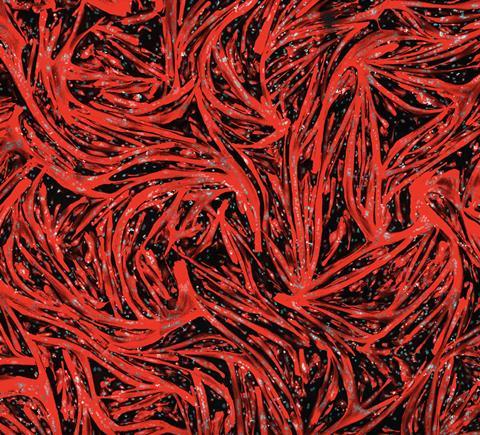
Another challenge is getting the cells into suspension, with sufficient robustness to withstand the forces in the bioreactor. The adult stem cells Flack’s group works with still adhere to a surface. In that regard, there are several paths to choose from. For instance, some cultured meat researchers and companies work with pluripotent stem cells, a different type of cell that can already grow in suspension to form aggregates. The downside is that their differentiation into the correct muscle or fat cells is very difficult to achieve without genetic modification. ‘Our own stem cells, derived from cow muscle, grow into the desired cell type without this need. But for us, the major challenge is culturing a large number of cells in suspension.’
Building texture
At the MERLN Institute for Technology-Inspired Regenerative Medicine in Maastricht, researchers are working on the next step: structuring cells into actual meat products, such as a steak. David Kilian focuses on the fabrication of biomaterials for this purpose, for example, to cultivate muscle cells into muscle tissue. ’Meat is a complex combination of muscle, fat tissue, and extracellular matrix’, he says. ’If we want to make a whole steak instead of burgers and sausages, we’ll need tissue engineering. What scaffold made of edible material can we design to grow cells into the desired 3D structure?’
Kilian draws inspiration from the medical expertise at the MERLN Institute, which spans from stem cell biology to tissue regeneration. ’Many of the challenges surrounding tissue regeneration in the medical field are similar to those of cultured meat. We’re exploring which techniques from the biomedical world can also be used to create larger tissues for cultured meat.’
’Even if we are eventually able to grow billions of muscle and fat cells, the challenge remains of how to assemble them into muscle tissue.’
David Kilian, MERLN/Universiteit Maastricht
Additionally, they study the use of 3D bioprinting techniques to create a meaty texture. A major challenge here is that muscle and fat cells require very different nutrients and mechanical properties in their environment to grow. ’Muscle cells are highly sensitive to the mechanical properties of the scaffold, which influences their protein production’, says Kilian. ’We’re looking for materials on which muscle and fat cells can grow and work together. On top of that, we want to incorporate the right mechanical properties that you’d expect when chewing meat.’
Hybrid form
Within MeatUp, various partners are working on the development and scaling up of these materials, which are for example based on algae and seaweed. Kilian: ’Even if we’ll soon be able to grow millions and billions of muscle and fat cells in the lab, the puzzle remains of how to bring them together into muscle tissue. I therefore believe cultured meat will take on a hybrid form, where we use not only animal cells but also plant-based components to shape the tissue.’
’It’s unrealistic to think that as soon as the technological puzzle is solved, we’ll all switch to meat from bioreactors’
Joshua Flack, TU Delft
As a next step, Kilian hopes to combine muscle cells and fat tissue into a thick piece of muscle tissue. ’To do this, we need to keep pushing the technology forward. We still have some fundamental challenges to solve.’
Flack, who previously served as Head of Cell Biology at the Dutch cultured meat startup Mosa Meat for five years, also believes that cultured meat still requires a few more innovations: ’If you had asked me about the promise of cultured meat during my first few months in the industry, I would have been very optimistic about it being in the supermarket within a few years. But the technology is simply very difficult to get right.’
Regardless, Flack observes a growing societal realization that we need to adapt our food system. ‘The long-term prospects for cultured meat are still good. However, it’s not realistic to think that as soon as the technological puzzle is solved, we’ll all switch to meat from bioreactors. I think cultured meat will instead make an important contribution to the transition towards various forms of alternative food.’


Nog geen opmerkingen