
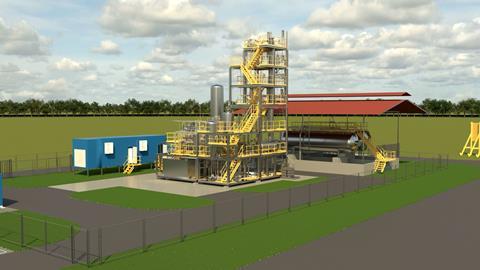
The increasingly prominent role of batteries is driving growing demand for battery materials, including battery fluids based on cyclic carbonates. Alta Group is working on scaling up a process to produce cyclic carbonates and derivatives from captured CO2.
The plan to use CO2 as a raw material for producing solvents for the battery industry has been on the priority list of Frank Vergunst, CEO of Alta Group, for several years. One of Alta Group’s core activities is the engineering of CO2 capture systems. As early as 2014–2015, the idea arose to do more with captured CO2. ‘At the time, we compiled a list of 30 interesting molecules that could potentially be produced from CO2. Cyclic carbonates were also on that list. But back then, the price for a ton of CO2 was between 5 and 6 euros, making it economically unattractive to install CO2 capture systems.’ Times have since changed, and the price in the emissions trading system is now between 70 and 75 euros per ton, making a business case more likely.
Negative LCA
Alta Group recently announced that it is investing in a pilot plant for the production of 3-methyl-2-oxazolidinone. ‘MeOx’, as Vergunst calls it, ‘sounds a bit easier than the chemical name.’ MeOx is a derivative of a cyclic carbonate and is an interesting alternative to toxic—and in many countries banned—solvents such as N-methyl-2-pyrrolidone (NMP) and dimethylformamide (DMF). These solvents are used in the battery sector, among others, but also, for example, in the production of semiconductors and in the coatings industry.
Using CO2 as a feedstock, cyclic carbonates become drop-in chemicals with a negative LCA (life cycle analysis), Vergunst explains: ‘Our process uses 80 percent less energy than current production methods for these chemicals. Also, thanks to the use of a highly selective catalyst, our product has a much higher purity. That makes these products very suitable for use in batteries. In addition, we can produce locally, which allows us to align with the European goal of energy self-sufficiency.’
De-risking
Ten years ago, the company began the preparatory work to build a large-scale demonstration plant for the production of cyclic carbonates in Zeeland. Permits and an electricity connection were applied for, an option was secured on a six-hectare site, and potential CO2 suppliers were sought. Vergunst attributes the delay partly to the permitting process: ‘The nitrogen issue in particular caused delays. Although our process does not emit nitrogen, we had to specifically demonstrate that. If there’s a change anywhere—in the project or the surrounding area—it has to be proven all over again. That takes two to three months each time; if you have to do that five times, you end up with a significant delay in the permit application.’
Securing an electricity connection, given the current grid constraints, was no easy feat either. But once again, the biggest hurdle turned out to be financing the project. ‘It’s not easy to bridge the financial gap between a pilot project and large-scale production. Banks only get involved when it comes to a profitable factory. For other financiers, a demonstration project is often too big or too small, or the development is moving too fast or, conversely, too slow.’ But with a previously obtained European JTF grant and Innogo funding from the Province of Zeeland, Alta Group can now begin further development of MeOx production on a pilot scale. ‘We’ve essentially carried out a de-risking process and are now moving forward on a smaller scale.’
Slightly exothermic
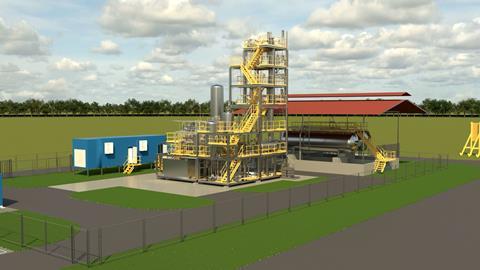
In Delft, Alta Group has already set up a pilot plant capable of producing cyclic carbonates from CO2 and epoxides. Alta Group is now building a pilot plant for the production of MeOx. This facility will have a capacity of approximately 200 liters per week. Vergunst expects it to be operational within six months. ‘With our current pilot, we can produce two different cyclic carbonates. One of these serves as a feedstock for MeOx. That process also produces MPG (monopropylene glycol).’ Alta Group holds a patent on the process for producing cyclic carbonates as well as on the catalyst. ‘The heterogeneous catalyst is highly selective for the conversion of CO2 with epoxides in the liquid phase. The reaction takes place at normal pressure and is slightly exothermic.’
’This also allows us to produce locally, thereby aligning with the European goal of self-sufficiency.’
Frank Vergunst, Alta Group
Thanks to the mild reaction conditions, virtually no byproducts are formed. In a second step, the cyclic carbonate is converted into MeOx using an amine. The first part of the process has already been developed to TRL7 (technology readiness level, where 7 denotes a demonstration in an operational environment). With the investment in the new pilot, the second step will also be further developed to TRL7. The new pilot will produce samples on a liter scale, allowing Alta Group and its customers to conduct trials for various applications.
Kiloton scale
Alta Group already has a clear plan for the next steps. Following the pilot plant’s test period, a demonstration plant with a capacity of half a kiloton per year is set to follow. Financing for this plant has not yet been finalized. ‘We are in discussions with various parties to see if we can already conclude off-take agreements for this. If we can demonstrate that there is market demand, the project will also become more attractive to investors.’ Vergunst believes that it will ultimately be possible to convert up to 10 million tons of CO2 per year (roughly half of the annual emissions from the Port of Rotterdam) into chemicals.


Nog geen opmerkingen