



A team from Nijmegen and Amsterdam has published a model-driven strategy in Nature Chemistry for adding the right substances to reaction chains at the right time. This time-dependent dosing strategy not only makes complex reactions more efficient, but can also make them more cost-effective.
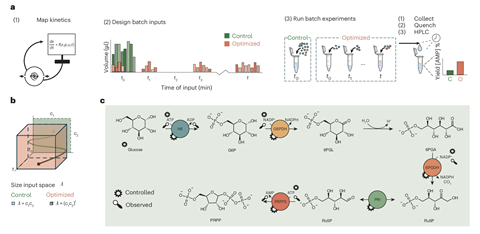
Wilhelm Huck’s group (Radboud University), in collaboration with Bob van Sluijs (University of Amsterdam), developed design strategies to increase the yield of enzymatic reaction networks (ERNs). Using models, they determined how—and, more importantly, when—substances should be added to such systems to achieve maximum yield. The work was published on May 6 in Nature Chemistry. Huck explains where the idea for this research came from: ‘The realization that there are so many possibilities for improving the yields of complex reactions by explicitly taking the time factor into account.’
No walk in the park
An ERN typically consists of enzymes (the catalysts), substrates (the starting materials), and cofactors such as ATP (adenosine triphosphate), and involves a multi-step organic synthesis route, in which each step is an enzymatic conversion. This can be carried out as a one-pot synthesis, but it is no easy task to bring all components together in the correct concentrations from the start to achieve optimal yield. For example, many enzymatic reactions are reversible, causing products to be converted back into the starting materials. Furthermore, different reactions often compete for the same cofactors, which can sometimes cause one reaction pathway to dominate while others stall, or result in an intermediate product that inhibits one of the enzymes.
Endless recipes
Huck, Van Sluijs, and colleagues investigated what happens when, in an ERN, you don’t add all the ingredients at once, but instead dose the components at different times. Huck: ‘We wondered: what if you could add whatever you want at any given time?’ In doing so, they put the classic batch approach (“mix everything and wait for steady-state”) to the test. ‘We’ve shown that with time-dependent additions, you can steer the system toward a much higher yield’, says Huck.
To illustrate how important timing is in reaction networks, they provide an example in their paper. Eight reaction components, each with ten possible dosages, already yield 108 combinations. But if you also take into account when components are added—for example, spread over 24 time steps—that number grows to (108)24 possible recipes.
‘We have shown that time-dependent additions can be used to steer the system toward a much higher yield’
Wilhelm Huck
The main hypothesis behind this work is that, among the vast number of possible dosing regimens, there are patterns that you wouldn’t necessarily think of on your own, but which do yield much higher yields. However, you can’t simply try them all: enzymes and cofactors are too expensive and too scarce for that. Moreover, the possibilities are almost endless.
Dosing schedule
This is where Van Sluijs’ strategy comes in handy. First, he had a model determine which experiments needed to be conducted in order to understand the behavior of an ERN as efficiently as possible and to model it accurately. He then used the data on how all relevant chemicals in the reaction network (substrates, intermediates, cofactors, and end products) evolve during the reaction to train and test multiple mathematical models of the system. Subsequently, he selected the model that makes the best predictions about which substances to add, when to add them, and in what order and quantities. In other words: the dosing schedule.
Huck and colleagues tested two enzymatic reaction pathways (the pentose phosphate pathway and the nucleotide recycling pathway) in a flow reactor in two ways: using the classic all-at-once approach and using model-optimized, time-dependent dosing schedules. The model-driven schedules clearly yielded more end product. In the pentose phosphate pathway, approximately 5.7 times more AMP was produced, and the conversion of glucose to product increased from about 12% to 48%. In the nucleotide recycling pathway, the staggered additions better balanced competing reactions, resulting in a UTP yield approximately 21 times higher than with the standard approach.
Just like baking
‘It’s just like baking’, says Huck. ‘You could just mix everything together all at once, but with most recipes, you have to mix, knead, add a few more ingredients, let everything rise, and only then put it in the oven. Basically, what we’re saying now is: with this method, I can give you a recipe. And if you follow it, you’ll get much better results.’
What about scaling up? ‘Then there are additional parameters like stirring, mass transfer, and heat transfer that we’re not currently accounting for in the model’, says Huck. ‘I think you have to view scaling up itself as a time-dependent recipe. If you really have to stir kilos of material, you can stir hard or soft, fast at the beginning and slow later. You can automate those parameters. But at the moment, we haven’t included that.’
An important next step is creating formulations, according to Huck. ‘So, turning all process steps—such as mixing, stirring, shaking, and so on—into a time-dependent recipe. Then you’re moving toward optimizing chemical technology.’ Together with Van Sluijs, he is considering starting a company that can apply these models to other systems. ‘But then people have to be interested in time-dependent recipes,’ says Huck. ‘For that, we need more examples to show that we can optimize multiple synthesis routes or formulations.’
Miglė Jakštaitė, et al., Timed batch inputs unlock substantially higher yields for enzymatic cascades, Nature Chemistry (2026), doi:10.1038/s41557-026-02138-1





Nog geen opmerkingen