


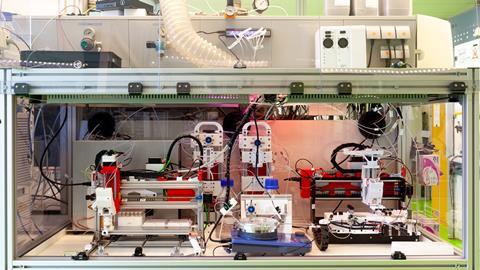
Chemists in Amsterdam recently launched RoboChem Flex in Nature Synthesis: an autonomous laboratory system that performs syntheses using flow chemistry and analyzes the results to determine the optimal conditions. And it’s up to the user to decide what ‘optimal’ means.
Self-managing or autonomous laboratories can accelerate scientific research by having machines and robots take over tasks. Think of things like preparing samples, carrying out chemical reactions, and analyzing data. Well-known examples include large-scale, highly automated platforms such as those in the pharmaceutical industry or Lee Cronin’s ‘Chemputer’ (University of Glasgow).
Yet there is a significant drawback to this development. Many of these autonomous labs require specialized, expensive equipment and a considerable amount of technical expertise. This makes them difficult for many research groups to access, especially for smaller or less well-funded labs.
The research group led by Professor of Flow Chemistry Timothy Noël (University of Amsterdam) recently presented an affordable alternative in Nature Synthesis: RoboChem Flex. This autonomous laboratory system, which costs approximately five thousand euros, optimizes syntheses in organic chemistry.
Optimal conditions
First: what exactly does RoboChem Flex do? The device synthesizes chemical compounds using flow chemistry. A robot takes small amounts of starting materials, mixes them, and passes the mixture through a reactor where LEDs trigger the reaction via a photocatalyst. An automated NMR spectrometer then analyzes the resulting molecules. In addition to photocatalysis, other types of chemical reactions can also be performed, such as biocatalysis, thermal cross-couplings, and enantioselective catalysis. All data is transmitted directly to the computer that controls the system.
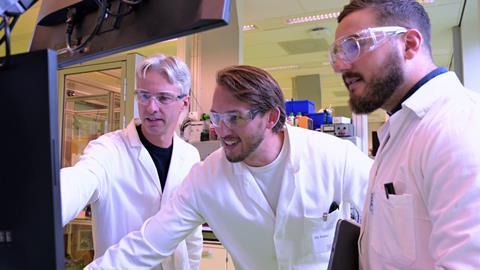
Timothy Noël with co-authors Oliver Bayley and Elia Savino
Source: HIMS / UvA
That computer serves as the ‘brain’ of RoboChem Flex. Using artificial intelligence—specifically, Bayesian optimization—the system independently determines which experiments are most meaningful to perform next. Instead of testing randomly, the model learns from previous results and selects new conditions that are either promising or particularly informative. Users can define for themselves what ‘optimal’ means: maximum yield, minimum reaction time, high selectivity, or a combination thereof.
The system’s hardware components ‘communicate with each other’ via open-source software developed by Noël and his colleagues. As a result, users need little programming knowledge: they can easily install the system, connect the components, and start using it almost immediately. According to Noël: ‘The publication contains all the information laboratories anywhere in the world need to build their own system.’
Faster and more systematic
According to Noël, the advantage goes beyond speed alone. ‘You can run more experiments faster, even at night or without human supervision’, he explains. ‘But just as important is that you can investigate complex combinations of variables much more systematically than is feasible manually.’
This has substantive implications for research. Because the system searches much more broadly, there is a greater chance that better solutions will be found and that researchers will not get stuck in a local optimum. At the same time, the role of the researcher is shifting: less time is spent on repetitive tasks, and more on hypothesis formation, interpretation, and strategy. Moreover, experiments can be conducted more safely because less direct human intervention is required.
From €50.000 to €5.000
The Amsterdam team had previously built an autonomous lab system. That model, from 2024, cost around fifty thousand euros—and that didn’t even include the expensive analytical equipment.
The successor is therefore significantly cheaper. According to Noël, the modular design, featuring 3D-printed and standard components, significantly reduces costs and also makes the system more flexible and easier to adapt. It can also be connected to existing analytical equipment, so labs don’t have to purchase everything new. The stated price of five thousand euros applies primarily to a basic entry-level configuration; more extensive, fully automated setups are more expensive but can be built up step by step.
Different from the rest
According to Noël, RoboChem Flex distinguishes itself from other autonomous labs through three key principles: flexibility, affordability, and broad applicability. While many existing systems focus on a single specific task, such as pipetting or a particular type of screening, RoboChem Flex combines multiple functions into a single platform.
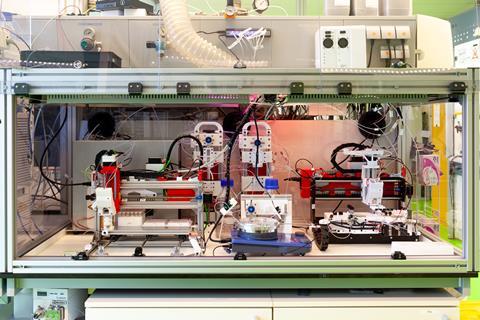
A key technical difference is the focus on flow chemistry. This approach offers advantages such as better control over heat and mass transfer, high reproducibility, and relatively simple upscaling of microscale experiments, says Noël.
Versatile
To demonstrate its versatility, the researchers tested RoboChem Flex in six diverse case studies. These ranged from photocatalysis and biocatalysis to cross-couplings and asymmetric catalysis.
In these studies, the system performed both single and multiple optimizations, integrated various analytical methods, and scaled up the optimal conditions identified. Importantly, all syntheses proposed by the system were subsequently carried out manually in the lab and validated.
In addition, the researchers used RoboChem Flex to repeat experiments from previously published studies as an additional test of reliability and reproducibility.
Lower threshold
‘Scientific progress benefits from widely available, affordable, and scalable equipment’, says Noël. ‘We want to prevent automation from primarily further strengthening the best-equipped labs. By lowering the barrier to entry, we hope to enable broader participation in data-driven chemical research.’
Moreover, development is not standing still. In Amsterdam, several systems are now running at full capacity, and new applications are in development. A next step could be, for example, an even more compact or portable version.
In the video on this page, Timothy Noël explains how RoboChem Flex works.
Simone Pilon, Elia Savino, Oliver M. Bayley, et al., A flexible and affordable self-driving laboratory for automated reaction optimization, Nature Synthesis (2026), doi:10.1038/s44160-026-01053-







Nog geen opmerkingen