


Researchers at the University of Twente have designed self-propelled rods to study how bacteria move collectively. Their size and shape anisotropy were found to be decisive factors in their collective behavior. The study made the cover of Science.
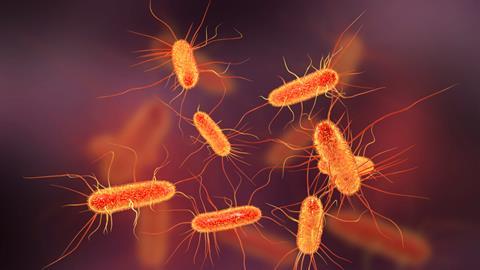
Motile bacteria such as E. coli or Bacillus subtilis exhibit varied collective movement behavior, ranging from swimming individually to moving together in swarms. When a large number of bacteria come together, the cells can become stuck, resulting in a biofilm: a layer of microorganisms that adheres to surfaces and is therefore difficult to remove. This can have adverse consequences, for example when these films grow in water pipes or around medical implants. In search of a solution to this problem, scientists are investigating which bacterial properties drive the formation of a biofilm.
Because bacteria carry out so many biological processes—responding to chemical signals, sensing their environment, and so on—it is difficult to determine what drives their collective behavior. To eliminate this biological complexity, researchers at the University of Twente designed synthetic light-driven rods that simply move. This allowed them to study which physical laws govern the behavior of the synthetic bacteria. In doing so, they focused on the shape and size of the rods. Physicist Hanumantha Rao Vutukuri of the University of Twente led the research: ‘If we learn to understand how swarming bacteria form a biofilm, we can start thinking about how to prevent this.’
Propelling rods
To mimic bacteria such as E. coli as closely as possible, the physicists at the University of Twente designed synthetic rods with similar dimensions. They created rods of varying lengths. Vutukuri: ‘Our rods are about a hundred times smaller than a human hair. They look just like matches, with a ‘motor’ on one end that generates the force to propel them forward.’
That motor utilizes chemical gradients. The colloidal rods, consisting of a head of titanium dioxide (TiO₂) and a tail of silicon dioxide (SiO₂), sink to the bottom of the observation chamber due to their weight, where they swarm around via Brownian motion. By shining a green light on them, the researchers induced a redox reaction between fuel components (hydroquinone and benzoquinone) at the head. ‘This reaction generates local chemical gradients, which propel the rods along their long axis toward the head.’
Sweet spot
To explain the motility of the rods, Vutukuri uses the analogy of a congested highway. ‘Depending on the size of the cars, their convergence in traffic can lead to a traffic jam. Similarly, the size of bacteria determines how well they move past one another.’ The researchers began their study with the hypothesis that motile bacteria such as E. coli have evolved to a size that allows them to move ideally through dense bacterial populations. ‘We suspect that they have found a ‘sweet spot’ in terms of size for collective movement.’
Using their synthetic rods, the researchers were able to study this hypothesis in detail. They observed that short rods clumped together, while long rods swirled around in formation. And indeed, somewhere in between, the researchers discovered something remarkable. Rods with an average length-to-width ratio exhibited active turbulence: a continuous, dynamic, and collective motion. E. coli exhibits the same behavior, which may contribute to the formation of biofilms.
The researchers also conducted simulations in which the rods were not in a liquid, but dry instead. In this case, no active turbulence occurred. ‘One of our key conclusions was that hydrodynamic interactions play a very central role in this behavior.’
Pushing and pulling
As a next step, Vutukuri now plans to literally expand the experiments into the third dimension, with the help of a recently awarded Consolidator Grant. ‘Our rods swim in two dimensions, but of course we live in a three-dimensional world. That’s why we want to start creating materials in which the moving rods can move in three dimensions.’
In addition, the researchers will study the influence of the rods’ direction of movement. ‘Our current rods are “pushers”; they push forward and thereby disrupt the flow fields around them, reducing the effective viscosity. But there are also bacteria that pull backward. As a next step, we therefore want to create synthetic “pullers” and see how this influences collective movement behavior.’
Y. Shelke, A. Nair, H.R. Vutukuri, Shape anisotropy governs organization of active rods: Swarming, turbulence, flocking and jamming, Science (2026), doi:10.1126/science.ady7618






Nog geen opmerkingen