
Using a combination of traditional fermentation techniques and carbon capture and utilization (CCU), the Antwerp-based startup Calidris Bio aims to demonstrate that new, sustainable protein sources are a viable alternative for the food industry. ‘Our role is to show that this can truly be done on a large scale.’
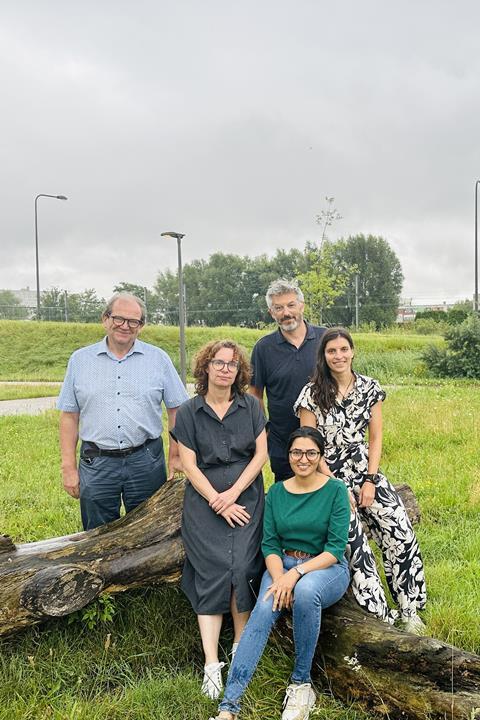
‘The climate crisis is upon us, but apparently no one in the food industry is doing anything about it’, begins Lieve Hoflack, co-founder of Calidris Bio. ‘And yet that’s exactly what’s needed. Our global food system—from the farmer to the processing industry—is responsible for no less than thirty percent of global greenhouse gas emissions. Combined with an ever-growing global population that wants meat, this means the problem is only getting worse. So we thought: we have to try to bring a good and sustainable protein source to market ourselves.’
‘Our product typically has a crude protein content of more than eighty percent’
Brecht Vanlerberghe
That source is CDRIS, an abbreviation of the startup’s name, which in turn is named after Calidris, a genus of small wading birds found in the North Sea. These birds feed on microbial biofilms rich in high-quality protein. And that protein became the inspiration for CDRIS.
Carbon-negative
Hoflack and her colleagues are also using such bacteria, but are keeping the details under wraps for now. What is not a secret, however, is the unique production technology they have in mind. This is intended to be a synergy between traditional fermentation—such as in beer brewing—and carbon capture and utilization (CCU), but applied to microorganisms. In practice, this means that the bacteria are not fed with sugars, but with a liquid C1 feedstock, a product of the reaction between CO2 and (green) hydrogen. It is therefore even potentially a carbon-negative process; CO2 is removed from the air.
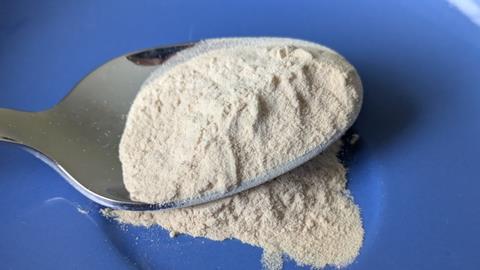
‘You can think of it as a soup’, Hoflack explains. ‘We feed the feedstock to our microorganism, and it grows until the soup is thick with protein.’ The medium is then harvested and dried. ‘It’s a bit like milk powder, but with a much higher protein content’, says Brecht Vanlerberghe, co-founder of Calidris Bio. ‘Our product typically has a crude protein content of over eighty percent. As far as we know, no other product based on biomass fermentation performs better.’
Currently, the feedstock is still sourced externally. Hoflack: ‘But eventually, we hope to link it to CCU. We have a patent application pending for that.’ Furthermore, Calidris Bio’s bioreactors are intended to form a closed system. ‘This will prevent nutrients from leaking into the environment, as happens with crops’, says Hoflack. ‘The water we use will be partially incorporated into our product and, in a future production facility, the remainder will be recovered.’
Hypoallergenic
Unfortunately, sustainability alone wasn’t enough to convince the market, as Hoflack and Vanlerberghe discovered when they launched the company about seven years ago. At the time, they were both working in the upscaling industry. ‘Due to the economic crisis, wars, and, unfortunately, a certain degree of desensitization to climate change, the importance of sustainability has taken a back seat.’
And so, for the past few years, Calidris Bio has been shifting its focus. ‘We’ve investigated the functional properties of CDRIS. The protein is hypoallergenic [tested on dogs with allergies, ed.] and performed very well in taste tests in products such as smoothies, chocolate mousse, 3D-printed ‘fish,’ and hybrid meat’, says Hoflack. ‘Most plant-based proteins don’t have the right structure for emulsification and gelling’, adds Vanlerberghe.
‘If we scale up to even larger volumes, we can expand into markets where price is the most important factor’
Lieve Hoflack
Currently, the lab facility is housed in the BlueChem incubator in Antwerp. Production takes place at a partner facility that currently produces batches of about 400 kilograms, but the team hopes to move toward full truckloads soon. And at the moment, that is primarily for the pet food industry. ‘There is a willingness to pay higher prices there’, explains Hoflack. ‘But if we eventually scale up to much larger volumes, we can still make inroads into markets where price is the most important factor. The human novel food procedure is, logically, very strict, because the products must be safe; if a single product with a problem enters the market, the entire sector takes a serious hit.’
Balance
Calidris Bio’s ultimate mission is to achieve carbon negativity in the food industry. ‘Because only then can you truly make an impact’, Hoflack explains. The team itself is also doing everything it can to improve its carbon footprint even further. ‘We want to do that by, for example, operating entirely on green energy. That’s not yet the case.’ Vanlerberghe adds: ‘We also want to make the process so efficient that we use less energy and need fewer chemicals to clean the equipment after a batch. And of course, we want to collaborate with partners who supply raw materials with an even lower footprint.’
We are currently in the midst of the so-called protein transition—the shift from animal to more plant-based (and microbial) proteins. You could even call it a “cellular agricultural revolution.” Does Calidris Bio indeed see this as the future of food? ‘I think it has to be a balance’, Hoflack notes. ‘There will always be some meat, but it will be significantly supplemented with plant-based alternatives. Our role is to demonstrate that this is truly feasible on a large scale.’
The start-up section is made possible by Pivot Park Oss
Accelerating in biopharma: starting out at Pivot Park
For entrepreneurs starting in the biopharmaceutical sector, the Pivot Incubator program offers the perfect springboard. Start-ups gain access to fully equipped labs, flexible office space, and a starter package with essential equipment. In addition, there is personalized guidance, access to experienced mentors, and a powerful network of experts and investors.
Community events and knowledge sharing encourage collaboration and growth from day one.
Interested in launching your initiative at Pivot Park? We would be happy to explore how Pivot Incubator can add value.
Pivot Park in Oss is the hotspot for companies and knowledge institutions in the biopharmaceutical industry. On this campus, more than 1,000 professionals work at some 65 start-ups, scale-ups, and established companies. Pivot Park is more than just a location: it is an ecosystem where innovation and entrepreneurship come together. A place where the healthcare of tomorrow is being built.



Nog geen opmerkingen