


Europe wants to start mining more critical raw materials itself. The best-known of these is lithium. In Germany, it is extracted from deep underground along with hot water. ‘Logically, we do this in the areas with the highest lithium concentrations.’
Thomas Kölbel is holding a jar of white powder in his hand. It looks like salt, and essentially, that’s what it is. However, it’s not table salt or sea salt, but a lithium salt: lithium carbonate. The powder is locally sourced; it is extracted from water that comes from deep underground here. After all, we are at the geothermal power plant of the German energy company EnBW in Bruchsal, near Karlsruhe. The plant is fed with water from a hot water layer located 2.5 km deep. When the water comes to the surface, it is 127 degrees Celsius—hot enough to generate electricity. The geothermal power plant thus produces 3 gigawatt-hours of electricity annually, enough to supply about 1,500 households with power. In addition, it also supplies heat to nearby buildings via a thermal network.
Geothermal energy is as “green” as it gets. But the Bruchsal plant has something else sustainable to offer. That’s right: lithium. The 883,000 cubic meters of water that pass through the plant each year can yield up to 800 tons of lithium, says Kölbel—a geologist who ended up working in EnBW’s geothermal division. That’s enough to make twenty thousand lithium-ion batteries, the most commonly used batteries in electric cars. It would at least make the German automotive industry a little less dependent on imports of this so-called critical raw material.
Porous materials
But that’s still a long way off. The lithium powder that Kölbel proudly shows us was extracted in a pilot plant, where the technical aspects of lithium extraction from geothermal water are being investigated. The plant is at TRL level 7 (technology readiness level), which indicates a demonstration of a pilot plant in an operational, realistic environment—in this case, the Bruchsal geothermal power plant. The research will have to show whether the plant meets expectations and whether it is worth scaling it up, after which the extracted lithium can actually be sold. Although EnBW has yet to make the decision to scale up, the company is already aiming for 2030 as the start of commercial production.
‘Lithium can be extracted as a byproduct of geothermal energy, which is actually an advantage’
Hans van ’t Spijker, Witteveen+Bos
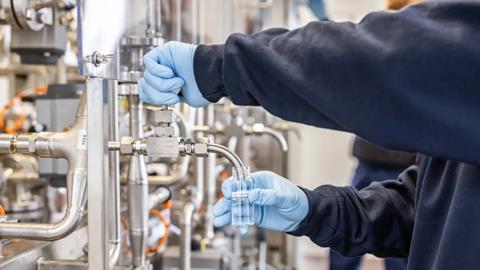
The pilot plant uses a branch line from the power plant’s main water circuit. The water is channeled through thinner pipes to filters equipped with sorbents developed specifically for this purpose—porous materials in which (or on which) lithium becomes trapped. Kölbel boasts that it takes only a few seconds to extract the lithium from the water. He compares this to the large production sites in South America, where one must wait many months before the lithium precipitates as residue in vast evaporation ponds. The geothermal lithium (lithium carbonate) is also very pure. Up to 99.5 percent, according to Kölbel.
Fault zone
Bruchsal owes its geothermal potential to its location in the Upper Rhine Graben, a geological fault zone that runs along the German-French border. Elsewhere in that region, the subsurface is also suitable for combined energy and lithium extraction using geothermal energy. The Australian company Vulcan Energy is also aiming for commercial lithium production at other sites by the end of the decade.
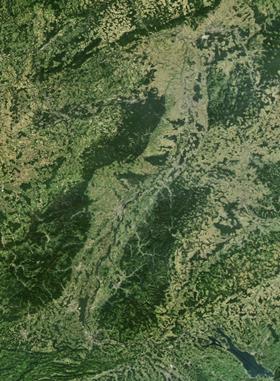
But there are opportunities outside the region as well. An extension of the Upper Rhine Graben reaches into the southern Netherlands and eastern Belgium. In the Flemish municipality of Mol, near the border with the Netherlands, the research institute Vito has been conducting research into geothermal energy for years—which led to the construction of a power plant to heat its own site. Lithium has also been found in the water from deep underground. This prompted a Vito spin-off to begin exploring lithium extraction from geothermal energy.
After it was announced in 2023 that the lithium concentration was approximately 100 milligrams per liter (or 100 ppm), the CEO of the spin-off speculated in the Belgian newspaper De Tijd about an annual production of 500 tons of lithium. The article also noted the interest of materials and recycling company Umicore, which produces materials for batteries, among other things. But apparently, it remained merely a non-binding interest, according to an email to Umicore. The company is not involved in the research in Mol. This is despite the fact that it does collaborate with Vulcan Energy in Germany.
This is in line with the conclusions of a study on lithium extraction from geothermal energy commissioned by the Dutch government in 2023. The study found that commercial exploitation is only feasible when lithium concentrations in geothermal water are high. ‘Below the threshold of 50 ppm, lithium extraction is not economically viable, because the costs then exceed the revenues’, says Hans van ’t Spijker, an engineer at the consulting firm Witteveen+Bos, which conducted the study. Geothermal sources were studied at various locations in the Netherlands, including in the Westland region and in the northern Netherlands. In every case, the concentrations were below 50 ppm.
Asset
Nevertheless, Van ’t Spijker does not completely rule out geothermal lithium extraction in the Netherlands. He sees two trends that could still make for an interesting economic case if they continue. ‘The technology for extracting lithium from water is improving rapidly. As a result, the threshold value might be lowered. And economically speaking, we’re seeing lithium prices rise again. Until a few years ago, China was flooding the market with large quantities, causing prices to collapse. That’s no longer happening.’
However, the study clearly shows that geothermal sources with higher lithium concentrations are more economically viable. Van ’t Spijker also points to Germany, specifically the Upper Rhine Graben, where concentrations often exceed 100 ppm—in Bruchsal, they are around 160 ppm. This may explain why Umicore is also looking primarily to Germany. Moreover, a source like the one in Bruchsal has a major advantage: the geothermal power plant was already in place when construction of the pilot plant for lithium extraction began. ‘Lithium can be extracted as a byproduct of geothermal energy, which is precisely an asset. For example, you don’t have to drill a new well’, says Van ’t Spijker.
’In the real world, the only thing that ultimately matters is the cost curve’
Peter Tom Jones, KU Leuven
Due to ongoing electrification, lithium prices are likely to continue rising for some time. That is why the study does not rule out the possibility that extraction from geothermal energy could also become economically or strategically (for example, as a raw material reserve) interesting in the Netherlands. Nevertheless, Van ’t Spijker continues to point to other countries. ‘It makes sense to organize this within a European framework, and then it’s logical to choose the locations with the highest lithium concentrations.’ He also cites sustainability requirements, which actually give lithium extraction from geothermal sources an edge over traditional extraction in evaporation ponds or mining. ‘Those requirements are European in any case.’
Skeptical
Lithium extraction from geothermal energy is carried out using a method called direct lithium extraction. In recent years, this method has also been attracting attention outside the geothermal sector—a great deal of attention, in fact. ‘Direct lithium extraction is pretty much the holy grail in our field’, said Bart Michielsen of Vito in an earlier article (from October 2024, in Dutch) in C2W | Mens & Molecule. Research into direct lithium extraction is therefore being conducted not only in Europe, but also in South America (as an alternative to evaporation ponds with their massive groundwater consumption and land use) and in North America (as a byproduct of oil and gas extraction).
Nevertheless, the method has also faced criticism. Skeptics argue that it has not yet moved beyond the testing phase. For them, lithium concentrations are also the main point of contention. ‘In European groundwater, these do not exceed a few hundred ppm, whereas in solid rock, concentrations often amount to several thousand ppm’, says Peter Tom Jones, head of the Institute for Sustainable Metals and Minerals at KU Leuven.
But evaporation ponds, just like traditional mining, take up a lot of space, whereas a geothermal power plant requires much less. Moreover, in addition to lithium, energy is also produced, both in a sustainable manner. And if it happens in Europe, that contributes to our energy and raw material independence. So perhaps there is something to be said for lithium extraction from geothermal energy after all? Jones: ’The key question remains what the cost of Li production from geothermal brines is. In the real world, the only thing that ultimately matters is the cost curve. If you’re on the wrong side of that curve—as is the case with geothermal lithium—you can’t count on much support from private investors.’






Nog geen opmerkingen