




Worry is a constant companion in early academic careers – about rejections, supervisors, career development, and much more. Isabelle Kohler offers help by introducing a simple but powerful distinction: the difference between what you can control and what you can’t.
It is Wednesday evening, after a long day at work. You’re on the couch, doing nothing in particular – which should feel like rest, but it doesn’t. Somewhere in the background, your brain is still running. The experiment that failed again this week. The number of months left before the end of your contract (fourteen, you counted yesterday!). The email your supervisor still hasn’t answered. The manuscript that has been out for review for five months now. You’re not working, but you’re not resting either.
Early in my academic career, I used to think this was part of the academic deal. Academia can be stressful, and it was quite usual for my stress to follow me home. What I didn’t realize is that there is a difference between carrying something that’s genuinely ours to carry, and spending energy on things we have absolutely no control over. And guess what – most of my work-related worries fell into the second category.
When I started my training in coaching and counselling, I bumped into a theory I wished I had known earlier: the Circle of Concern and Circle of Influence, first introduced by Stephen Covey in his book The 7 Habits of Highly Effective People. Everything you care about – at work, or in your life in general – sits in your Circle of Concern: the full range of things that occupy your attention. Inside that circle sits a smaller circle: your Circle of Influence – the things you can actually do something about.
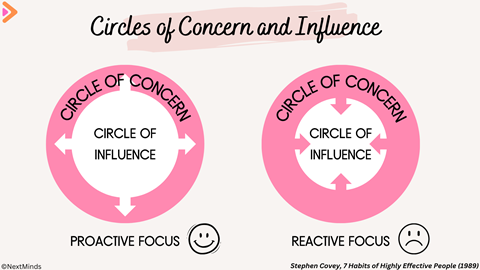
What does it mean for you if you’re a PhD student or postdoc? The truth is that most of what occupies your mental space sits in the outer ring: whether your manuscript gets accepted, whether your supervisor has time for you, whether the perfect job opens exactly at the moment you need it. That’s a lot to worry about, with very little leverage.
Academia doesn’t make this easier: we find ourselves with a tendency to turn structural uncertainty into personal failure. You didn’t get a grant? Maybe you should have worked harder on your proposal. Your paper was rejected? It wasn’t good enough. The system hands precarity back to us as our own problem to solve.
Covey’s point is the following: people who spend most of their energy in the Circle of Concern – worrying, ruminating, replaying scenarios that won’t change – tend to feel increasingly powerless. Their Circle of Influence actually shrinks. People who redirect attention to what they can influence tend to feel calmer and more capable. Their Circle of Influence tends to grow.
Take the weather to make this concrete – we’re in the Netherlands, after all:
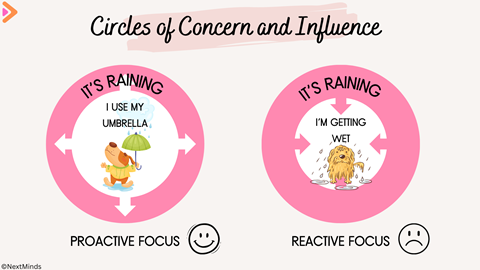
Rain is in your Circle of Concern: you cannot stop it. But you can decide how to respond to it – grabbing your rain jacket or an umbrella to stay dry.
The same logic applies to a manuscript rejection: you can’t control the reviewer who didn’t like your paper, but you can control how quickly you revise and resubmit. You can’t make your supervisor more available, but you can find other mentors and be more explicit about what you need. And the job market? You can’t force it to cooperate, but you can build skills and networks that open more options.
Of course, this model shouldn’t be used as a reason to accept what shouldn’t be accepted – a toxic lab or a collapsing publishing system. The Circle of Influence is a way to protect where your attention goes, so you can focus on what you can actually change.
The next time you find yourself on the couch with your brain running in the background, try to ask yourself: is this in my Circle of Influence, or not? If not, can it wait? If yes, what’s one small thing you can actually do?
The umbrella or rain jacket won’t stop the rain. But it keeps you dry enough to keep going.
If you are interested in learning more about how to navigate academia and learn better how to control your worries, do not hesitate to join the NextMinds Community! For this, you have plenty of choices: visit NextMinds website to learn more about my work, sign up for the newsletter, and follow me and NextMinds on LinkedIn.












Nog geen opmerkingen