


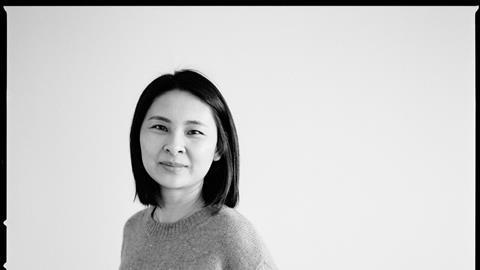
Danqing Liu employs her broad expertise to develop materials that allow a more varied sensory experience. ’Using our sense of touch is becoming more and more important in our digital world.’
Talking to Danqing Liu really puts your powers of imagination to the test. She effortlessly presents the most wonderful and wild ideas about the materials she’s working on, leaving the interviewer mentally grasping for air while trying to keep up and visualize the devices and applications which to her seem so obvious. Displays that allow you to feel an image; materials that, from a distance, can mimic your movements; data protection tools that don’t rely on binary code, but deploy defects in materials to create unpredictable ‘keys’. Just to give you an idea of the range of Liu’s research (and creativity).
As an associate professor of Human Interactive Materials within the Department of Chemical Engineering and Chemistry at Eindhoven University of Technology, she employs her background in physics, electrical engineering, mechanical engineering and materials research to develop not only adaptive, responsive materials, but also take the next step to turn these materials into prototype devices that offer real-world applications.
In February, Liu was awarded an NWO Vici grant of €1.5 million for her project ‘Beyond sight and sound: liquid crystal polymer-based tactile interfaces for the digital age’. A good motivation to learn more about her plans and why she sees a growing need for ways to use our sense of touch.
Congratulations on your Vici. It must be nice to receive such a budget.
‘Yes, it is very nice, but it’s not a lot.’
Sorry?
‘Well, it is sufficient, but it is not enough to do all that we want.’
But what cán you do with this sum?
‘It allows me to hire three PhD students and I get an additional postdoc position that is paid for by the department. And the Vici also covers part of my salary.’
And what will these new PhD students and postdoc work on within this project?
‘The best way to understand what this project is about is to think about how your daily life compares to that of blind people. You wake up, you look at a screen for all sorts of information. Most information we get through visuals and to a lesser part through auditive signals, like radio. In our digital world, the focus is on displays and touchscreens. But for the blind, these offer no opportunity to “feel” a pattern or “feel” an image. Braille boards only transmit text, but also not an image. We want to develop screens that allow people to physically feel a pattern, through protrusions in the screen.’
How did you come up with this idea?
‘It did not start from a wish to help blind people. This possibility emerged from a variety of insights and explorations over years of research. A display is essentially 2D and I thought it was interesting to explore more dimensions. Already back in 2013 I talked to people at Samsung about displays with protrusions, but they showed absolutely no interest. But we continued and years later, in 2024, I presented our work at the world’s biggest display conference and I was approached by Samsung people from different technology areas who were all interested in my results.’
And their interest changed, because…
‘By now, VR and AR are very well developed, but still very visual-oriënted. The haptics part of the technology is undeveloped, but it holds great potential for “feeling” various sensations such as warm/cold, hard/soft, smooth/rough etc. Haptics is studied from many different fields, like mechanics but also psychology and design. But materials that allow these sensations to be experienced still need to be developed. That is what we do, we develop the chemistry underlying haptics. I think that there is a growing need for the physical experience of touch. That sensation is becoming more important in the digital world. It’s not that I want to go back to the past, but I want to use modern technology to create the experiences that we as humans need. And we need our sense of touch. That is also why most of us prefer keyboards to typing on a tablet. It is also the reason why our phones are filled with haptics.’
’We develop the chemistry underlying haptics’
But how did you, as a materials scientist, get interested in haptics?
‘That started when I was working on “swimmers”; soft robotics-style materials that can move in water, but to stimulate their motion I had to design a material that could change its surface from smooth to rough and back. That changes the material’s resistance to the water and as such enables motion. When I first experienced that change from smooth to rough, it got me thinking about how this relates to our sense of touch and that is how I got interested in haptic technology.’
So, you just allow yourself to be surprised, take it from there and see how one thing leads to another?
‘Yes, my approach to research is very explorative, it’s completely discovery-driven. I don’t work from a hypothesis. Where I am now, with this Vici project, is the result of many pieces coming together that were developed during the past twenty years.’
That’s a long time.
‘It really takes time to discuss your ideas with others, also outside academia with industrial partners, to shape your ideas and to check whether they make sense and where potential applications could be. Working here with Dick Broer [prof.em. at TUE and former VP research at Philips, ed.], such discussions were also stimulated as he has a background in industry. For me, it has always been normal to dicuss my work with companies. That is why I really appreciate that NWO TTW [Applied and Engineering Sciences, ed.] demands that you set up a user committee with your project. It pushes you to think about potential applications and benefits. That suits me, because I’m an engineer, so I like to think about solutions.’
But is there also a more overarching, fundamental question that drives your work?
’In my view, fundamental and applied research are entangled. I cannot separate them. Take the protrusions on a screen. There are many typically “scientific” questions that we need to tackle. Like, how we can translate molecular properties to macroscopic behaviour? We know by now, through experience, which liquid crystal configurations of clusters lead to certain behaviour. And now we can apply AI tools to figure out more generic principles on how to configure those LC clusters. So that we learn which specific shapes result in which specific protrusions.
And there is also the question of how to drive the change in the material. For years, light was assumed to be the best and the most elegant trigger to induce change in materials, but when you work with devices they are all electrically driven. Which driver you choose, will define the molecular properties needed in the material.’
’For me, it has always been normal to dicuss my work with companies’
There are so many disciplines that come together in your work, can you talk us through your training and career choices?
‘Back in China, I started out in optical physics, followed by an MSc in electrical engineering at TU Delft working on semiconductors. Then I moved to TUE for a PhD in mechanical engineering and subsequently landed in materials research here in the chemistry department.’
You really embody multidisciplinary research that is so often promoted, but in practice it’s not always the easiest route.
‘When you switch fields, you will be running behind, in terms of career steps, compared to your peers. But I was lucky with each switch to find people who took me on, in spite of all my hopping between fields. My current group is also very mixed, we have people with a variety of backgrounds. It is very important, as I know myself, that people get the time and the chance to learn a new field. In my group, the chemists have to learn about electrical engineering and how to design a device, and vice versa, the electrical engineer needs to learn about chemistry.’
You said at the start that the Vici budget will not allow you to do all that you want, but how far will it take you? Do you have specific goals that you want to realise?
‘There are specific goals, connected to the students that I will hire. They will work on the soft-hard transition in the material, on topography of the surface and on the warm-cold sensations. But there are many more thing to explore.’
Such as?
‘How to control adaptive materials from a distance where the material mimics your movements. This could be, for example, applied to train materials to work in a hazardous environment by mimicking your movements while you’re in a safe spot. Or think about wearables, that allow you to comfort people when you talk to them online. The material recognizes your movements when you stroke your shoulder or give a hug, and then the other person “feels” your movement through the wearables. We have perception tests already going on. But there is a long way to go, we have different levels of complexity to conquer when you want turn a material into a device. That is a real challenge. But we know the material can do this. My aim is to take it to prototype-level and then a start-up can take it to the next stage.’
CV Danqing Liu
2026 NWO Vici grant
2023 Associate professor Human Interactive Materials, TUE
2020 Michi Nakata Prize for Early Career Achievements, International Liquid Crystal Society
2019 Assistant professor (Tenured), TUE
2016 NWO Veni grant
2013 PhD mechanical engineering, TUE
2009 MSc electrical engineering, TU Delft






Nog geen opmerkingen