


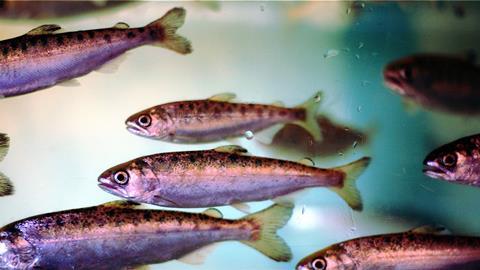
Every year, around half a billion kilograms of ‘tyre wear dust’ is produced by road traffic in Europe. This releases a significant amount of 6PPD-Q, an oxidation product of a commonly used tyre additive, into the environment. This substance has been found to be lethal to coho salmon, and a court case is currently underway in the US, with fishermen and environmental organisations taking on tyre manufacturers in an attempt to enforce a ban. The verdict is expected in May. In the EU, meanwhile, the Dutch RIVM and the Austrian environmental institute UBA are also working towards a ban.
For coho salmon in the US, a heavy downpour spells trouble. Since the 1980s, there have been reports of mass deaths within hours of such a downpour beginning. The salmon thrash about, gasp for air, lose their balance and float to the surface. The western US population has been considered threatened for decades, particularly around urban areas through which the salmon pass on their journey from the Pacific Ocean to upstream creeks where they spawn. Following downpours, local mortality rates of up to 90 per cent have been recorded.
It was not until 2021 that the cause of this urban runoff mortality syndrome was identified. A research team led by chemist and environmental scientist Ed Kolodziej at the University of Washington systematically separated the more than two thousand substances found in used car tyres until only the lethal substance remained. Their 2020 publication in Science reads like a true whodunnit.
The culprit is 6PPD-Q, an oxidation product of the antioxidant and anti-ozonant 6PPD (N1-(4-methylpentan-2-yl)-N4-phenylbenzene-1,4-diamine). This p-phenylenediamine keeps the tread of car tyres supple by scavenging ozone and oxygen radicals. It has been the most widely used antioxidant in the tyre industry for at least fifty years. A car tyre contains between 0.5% and 2% by mass of this substance. With 1.7 billion new tyres produced annually, this equates to millions of tonnes of 6PPD.
Their 2020 publication in Science reads like a true whodunnit.
Concentrations of tens of nanograms per litre of the oxidation product, 6PPD-Q, are already proving lethal to coho salmon (LC₅₀ = 41 ng/l; based on a Canadian study from January 2023), a common species along the US west coast. 6PPD-Q is mainly released when 6PPD ends up in the air or on road surfaces through ‘rubber wear’ and oxidises. Rainbow trout, brook trout, and East Asian white-spotted char also appear to be quite sensitive, while other fish species are much less affected. The manner and cause of death of the salmon from 6PPD-Q is still unknown.

In court
At the end of 2023, Californian fishermen and the NGO Earthjustice filed a lawsuit against thirteen of the state’s largest tyre manufacturers, including Goodyear, Michelin, and Bridgestone. ‘The wilful continued use of 6PPD is causing the extinction of the coho salmon and undermining the livelihoods of fishermen’, said Earthjustice. They are demanding a court ban on 6PPD in car tyres.
In early February, the parties faced off in court for three days. John Stark, a professor of ecotoxicology at the Washington Stormwater Centre, presented evidence against 6PPD-Q. The tyre manufacturers acknowledged that 6PPD-Q enters surface water via rubber abrasion and harms fish. However, they also argued that these effects are localised and that a direct link between 6PPD-Q and the decline in the salmon population cannot be proven. It is certainly true that warming seawater and habitat loss also threaten salmon. The judge is expected to deliver a ruling in May.
‘The water running off our roads must not be toxic to fish, aquatic plants or humans.’
Ed Kolodziej, University of Washington
Tunnel water
Logically, 6PPD-Q can be found anywhere in the world where lorries and cars drive. Bicycle tyres, shoe soles, and gym floors can also generate dust containing 6PPD-Q, but this pales in comparison to the contribution of traffic, particularly heavy traffic. According to the ADAC (the German Automobile Association), this produces half a billion kilograms of rubber dust annually in the EU. Roughly one per cent of this consists of 6PPD and 6PPD reaction products, including 6PPD-Q.
As far as is known, 6PPD-Q has not caused acute fish mortality in Europe. However, around Lake Annecy in France, which invests heavily to remain ‘the purest lake in Europe’, there is concern about declining salmon stocks, and initial measurements have been taken for 6PPD-Q and other rubber additives. The water contains concentrations of 6PPD-Q of up to 12 ng/L. This is consistent with the global situation, with concentrations of 6PPD-Q in surface water varying from a few nanograms to peaks of around 100 ng/L. While not acutely lethal to European migratory salmon, the long-term effects are unknown.
Last year, consultancy firm Geofoxx carried out the first and so far only measurement of 6PPD-Q in the Netherlands on behalf of Arnhem City Council. At a busy traffic junction near Rijnstate Hospital, 220 ng/L of 6PPD-Q was found in a sedimentation tank. ‘We chose a spot where there is logically a high chance of finding 6PPD-Q – a worst-case scenario’, explains Jeroen Oosterwegel, a senior consultant at Geofoxx. The result is not surprising: 6PPD-Q accumulates in water from road tunnels and in motorway drainage systems.
Proposal for restriction
6PPD has been nominated as a substance of very high concern (SVHC) in Europe, meaning it must be prioritised for removal from the environment. This is not based on fish mortality; 6PPD has been shown to impair the reproduction of rats and rabbits in animal testing. It is unclear whether this poses a risk to humans, but we too absorb the substance via particulate matter in the air. The Austrian environmental institute UBA has compiled a dossier advocating the ‘reproductive toxic’ label, which would classify 6PPD as an SVHC.
’We want to prevent regrettable substitutions.’
Patrick Zweers, Bureau REACH
The European process began at the Dutch RIVM. Patrick Zweers of Bureau REACH, which is part of the RIVM, says: ‘6PPD emerged during a scan for new environmental risks. The trigger was a scientific publication by the University of Washington.’ Together with Austria, the RIVM is now working towards a restriction proposal. The label will be ‘hazardous to the aquatic environment’: the red diamond, fittingly containing a dying fish.
Zweers has no doubt that 6PPD is a SVHC. Discussions in Europe mainly concern which related substances will be included in the proposal, and exactly how toxic 6PPD-Q is to aquatic life. Zweers says, ‘The ECHA’s scientific committee is reviewing this again using the latest data.’ Efforts to reduce 6PPD are also underway from another angle. Since the beginning of this year, Europe has imposed maximum limits on the amount of particulate matter that can be emitted from tyres per kilometre travelled (Euro 7 standards). This is being done to reduce particulate matter emissions.
Together with tyre manufacturers, Kolodziej has been searching for 6PPD alternatives for some time. There is a shortlist of seven potential candidates. Most of these are phenylenediamines too, he acknowledges, but they are less acutely toxic to salmon. Additive manufacturer Lanxess has previously proposed another phenylenediamine, CCPD, as an alternative. Zweers: ‘It is less toxic to fish, but the question is whether that is sufficient. We want to avoid regrettable substitutions.’ Rubber additive manufacturer Flexsys says it has a good non-phenylenediamine alternative. The product has already won an innovation award, but the substance’s identity has not yet been disclosed.
In an email, Kolodziej states that it is certainly possible to find a sustainable alternative ‘with the right commitment and resources’. However, research is not operating at full capacity. Significant budget cuts to environmental research in the US are being implemented under the Trump administration. Nevertheless, he believes that 6PPD will eventually be banned in the US as well. ‘I don’t know when or how we’ll achieve that, but water running off our roads shouldn’t be toxic — not to fish, aquatic plants or people.’
Zhenyu Tian, et al., A ubiquitous tire rubber-derived chemical induces acute mortality in coho salmon, Science (2020), doi: 10.1126/science.abd6951
Erratum bij Z. Tian, et al., Science (2022), doi: 10.1126/science.abo5785
Bonnie P. Lo, et al., Acute toxicity of 6PPD-Quinone to early life stage to juvenile chinook (Oncorhynchus tshawytscha) and coho (Oncorhynchus kisutch) salmon, Environmental Toxicology and Chemistry (2023), doi: 10.1002/etc.5568









Nog geen opmerkingen