


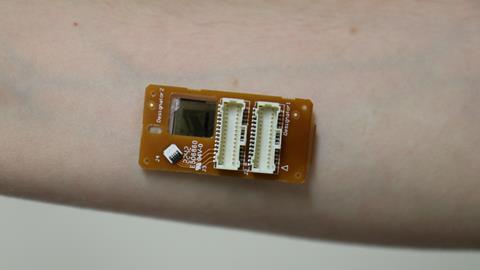
Sweat can easily perceived as a nuisance, but start-up DXcrete is developing a device to collect as much sweat from the skin as possible. Analysis of this essential body fluid offers a non-invasive way to monitor vital organs as sweat contains many relevant biomarkers. This could result in tools that allow, for example, monitoring kidney function from home.
When mechanical engineer Emma Moonen started her PhD-research in microsystems, she picked ‘sweat collection’ from the list of possible topics. The assignment appealed to her because it seemed both highly specific — create a device that collects sweat — and, even more important, very useful. Moonen: ‘Vitals such as your heartrate or oxygen saturation can be continuously monitored in an ICU setting. However, to check the liver of kidney function you need a blood sample. Therefore, a sudden deterioration of these vital organs may not be notified immediately. But as sweat also contains the biomarkers that are determined in the hospital lab, a device for continuous sweat collection could change that.’
Sweat, produced by the sweat glands in our skin, mainly consists of water which evaporates to regulate body temperature, but it also contains salts and other components in concentrations that often mirror their levels in blood. Sweat concentrations of for example creatinine and urea, both established biomarkers for kidney performance, correlate with blood levels. Continuous sweat analysis could thus offer a non-invasive way to check organ performance.
‘Most of all it is the autonomy that attracts me in starting my own company’
Emma Moonen
However, collecting enough sweat from the skin to ensure reliable lab analysis poses a serious challenge, and has for decades been the bottleneck in using sweat for health monitoring applications. At room temperature in rest, a square centimeter of skin excretes only around two nanoliters of sweat per minute. An amount too tiny to be used for the intended biomarker analysis.
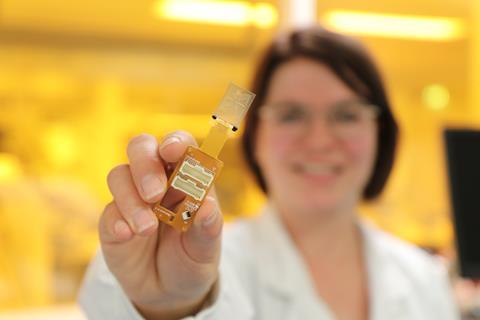
But advanced analytic techniques require increasingly smaller volumes for a reliable measurement, and using the microfluidic patch Moonen developed during her PhD-studies (cum laude), she succeeded in collecting already several nanoliters per minute from individuals in resting state. The patch is placed on the forearm and ‘milks’ approximately ten sweat glands separately, but simultaneously with microchannels. A patch under an armpit may seem more logical but sweat glands in the armpits are influenced by hormones and emotions, and produce oily substances too.
Autonomy
The promising results motivated Moonen to start a company and she successfully applied for a NWO Faculty of Impact-grant. ‘I’m truly in a position of luxury. This grant gives starting entrepreneurs two years to develop their invention to the level where it becomes interesting for investors.’ Moonen still works in the ICMS Microsystems-group where she also conducted her PhD-studies. ‘Also a luxury for a business starter. I’m working amid all kinds of experts, expertise and advanced equipment. I have even access to such things as the animation studio. In return, I’m available for questions from the community.’
‘I’m working amid all kinds of experts, expertise and advanced equipment, a luxury for a business starter’
Emma Moonen
In Timon Grob, Moonen found a business partner and co-founder. He is a materials specialist with experience in the medical industry and acts as the (currently parttime) CEO of DXcrete. The division of roles seems clear: Moonen is the technical expert, Grob the business specialist. ‘Yet, at this stage, these tasks are often highly intertwined; we consult each other over almost every decision’, says Moonen. ‘I’m learning a lot about business and every day is different.’
Entrepreneurship is not a life-long dream coming true for Moonen, but she enthusiastically seized an opportunity that resulted from her research. Moonen: ‘Most of all it is the autonomy that attracts me in starting my own company; the freedom to make my own choices and decisions. It’s not like I’ve said goodbye to research. Right now, that is actually still a large part of my work.’
CE-marking
After establishing proof-of-principle, Moonen and Grob took their time to decide which biomarker focus on for their first application. Based on both technical and commercial considerations, they decided on kidney monitoring via creatinine analysis. Moonen: ‘In proving some concepts, however, we also work on the detection of lactate which may be of interest for future sports applications.’
Moonen will soon be joined by two engineers. ‘We’ve succeeded in attracting grants for application research.’ Will they be the first of many DXcrete employees? ‘Yes, we’ll need not only technicians, but also marketing and business staff, once we have a first product for kidney function monitoring with CE-marking ready. There is a worldwide market for our products.’ Moonen expects DXcrete to reach that point within five years. Today’s work focuses on further optimising sweat collecting; an ongoing challenge for DXcrete.









Nog geen opmerkingen