



Creating a stimulating, mutually beneficial interaction between science and industry is the priority of the ICMS Industrial Consortium. ‘We try to meet the needs of all participants: ICMS, university faculty, industry and start-ups.’
When ICMS was founded, the importance of industrial partnerships was immediately recognized, resulting in the establishment of an Industrial Consortium. The aim of the ICMS Industrial Consortium is twofold: to tailor research to the challenges faced by industry and to make ‘knowledge of the future’ available to companies.
ICMS has advanced equipment, for example to characterize systems at single-molecule precision, from complex polymers to biological interactions. It also has multidisciplinary knowledge to solve problems using a radically different approach, says Partner & Program Manager Nicholas Tito: ‘Our broad expertise within ICMS spans from molecular fundamentals to advanced materials and engineering life. We can (re)architect materials and engineer molecular interactions for new biomedical devices and drugs. Think of companies that want to prototype a sensor to measure metabolic health in real-time, or new antibody-based therapeutics, or a more sustainable home cleaning product based on biomolecules as opposed to fossil-fuel-based ingredients.’ Tito enjoys collaborating with companies that are open-minded and enthusiastic about looking at problems in a new way. ‘You have to stay on the leading edge, and it has to remain exciting for everyone.’
Short distances
One of the companies with which ICMS has a long history of collaboration is Covestro. Long before Covestro was formed from the materials divisions of Bayer and the RFM part of DSM, there were already numerous collaborative projects with the researchers in Eindhoven. The short distance between the university and the Covestro site in Geleen was an important reason for this, says Damien Reardon, Science Fellow at Covestro. ‘Thanks to the proximity of the university, frequent physical interaction is possible, and you can work together more effectively to achieve common goals.’ Tito endorses the importance of personal contact: ‘One of the most valuable aspects of collaboration are the people involved. You have to find people who are willing to take the extra time to build a relationship.’
‘You have to stay on the leading edge, and it has to remain exciting for everyone’
Nicholas Tito
Nevertheless, there are differences between industry and academia that pose challenges. Reardon: ‘There is a difference in timelines, so it is important to adjust expectations accordingly and set joint goals. In research, you never know the outcome. About ninety percent of all new developments fail, but you do build up knowledge. However, it is difficult for a company to explain that you have achieved substantial growth in knowledge. As a company, you want to capitalize.’ Tito agrees: ‘We try to meet the needs of all participants in the Industrial Consortium: ICMS, the university faculty, industry and start-ups.’
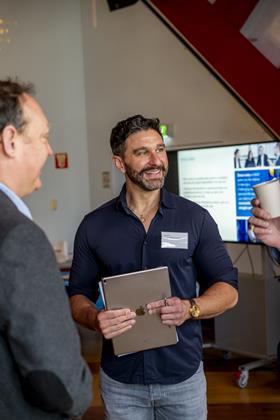
Tito has experience in both research and business, including as an entrepreneur running a start-up. This enables him to empathize with the priorities of the participants. ‘Professors care more about the value of the research in terms of curiosity, discovery, intellectual growth, and dissemination, rather than the economic aspects which are of interest to companies. In bringing together all the stakeholders in joint academic-industrial collaborations, you need to find the right tone of voice.’
Tito’s task is in a way comparable to that of a concierge, he explains: ‘The concierge receives tough scientific questions from either the companies or the scientists and looks for the best connection to tackle them. Some questions involve just a couple of laboratory experiments, while others can lead to multi-year joint projects. In this way, I help enhance matchmaking within the Consortium.’ The so-called Think-Tank Workshops are also a successful concept. ‘Researchers from large companies present two or three scientific challenges, and ICMS researchers can contribute ideas. This can lead to unorthodox and future-oriënted solutions.’
Innovative link
One of Tito’s key ambitions for the Consortium is to create more engagement of start-ups. To this end, ICMS organizes a range of activities. For example, Tito invites the founders of start-ups to give a short introductory presentation to researchers and other Consortium partners. ‘The intent is to share their stories and challenges, not only scientific challenges, but also what it is like to be an early-stage entrepreneur. We see that masters- and Ph.D.-students are interested in pursuing a career outside the university laboratory. Setting up a company could offer an inspiring future. The start-ups that were created here can serve as mentors on the journey to becoming an entrepreneur.’
‘The developments of the start-ups can be the innovative link between the university laboratory and our products’
Damien Reardon, Covestro
Covestro is strongly committed to supporting start-ups as well. ‘We are also interested in the ICMS-startups because their activities are close to what we do. The developments of the start-ups can be the innovative link between the university laboratory and our products. We can help them bringing their innovations to the market and leverage the financial risk in scaling up.’
Attracting talent
For companies, for the time being, the main motivation for collaborating with ICMS is to meet talented students. Reardon: ‘In the past, research was more of a joint effort with academia as innovation cycles were longer and more synchronized. That has changed, innovation cycle times have decreased, and industry seeks faster return on its investment. We now focus on hiring the right adaptable scientists as they are our most important asset.’
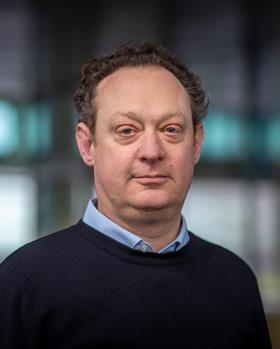
This is also related to a shifting focus in industrial research. ‘The chemical industry has to innovate faster and faster to stay competitive. The university educates young people, who will bring innovative ideas and ground-breaking knowledge that is applicable in many R&D-projects. Having a presence on the university campus lets us interact with students to understand who the best match to Covestro is. Our focus therefore is on the student’s capability to innovate, building on their acquired knowledge and critical thinking skills to develop a next generation of technologies relevant for the company.’
Companies also benefit from the available research infrastructure. For example, ICMS has highly advanced equipment for characterizing (non-)living matter at the nanoscale. ‘Thanks to the availability of cryogenic electron microscopy, we can monitor processes involving complex polymers at the particle level in the dispersed state,’ Reardon explains. Covestro sees it as an advantage that other companies are also participating in the Consortium: ‘We all face the same issues. With polymers, these issues concern sustainability, recyclability, end of life, micro- and nano plastics, biobased materials etc. Also, how we can accelerate innovation, strengthen our competitiveness, and take advantage of digitalization and data science.’ Reardon believes the partnership is important for the future: ‘It gives us good insight into what is cooking in the kitchen.’







Nog geen opmerkingen