


Multidisciplinary research is one those buzzwords that pop up everywhere. But creating an environment where scientists are eager to share their expertise requires more than mere lip service, says ICMS scientific director Jan van Hest. ‘Multidisciplinarity is not just a box to be ticked, but it is an absolute prerequisite to get ahead.’
Since 2017, Jan van Hest has been at the helm of ICMS, the Institute for Complex Molecular Systems at Eindhoven University of Technology. An institute that has only limited budgets for research but somehow manages to host a vibrant and highly successful scientific community of a few hundred members and students that span a wide range of disciplines and departments. The secret? ‘Researchers join ICMS because they want to work in this setting and be part of this community.’
ICMS prides itself on being a multidisciplinary institute. Is that the defining characteristic?
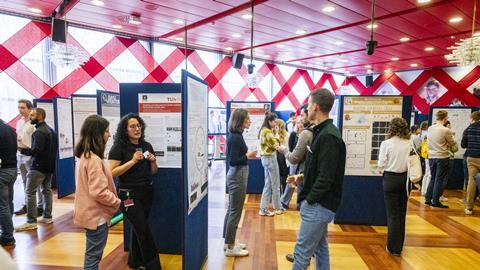
‘The essence of ICMS boils down to a community of talented and intrinsically motivated researchers from a wide variety of disciplines who together focus on a central theme. In our case: complex molecular systems, primarily in the context of materials. Everybody here understands that you need all these disciplines to be successful in this field. People join ICMS because they want to work in such a collaborative environment, it is completely voluntarily. It is all very informal here; we don’t have a strict hierarchy or a complicated management structure. And that is the reason we have a very collegial and open atmosphere where success is shared. We all see the added value of working together and joining forces. And it also means that topics like team science and diversity are simply everyday practice here. Multidisciplinarity is not just a box to be ticked or a goal in itself, but it is an absolute prerequisite to get ahead. Our approach attracts exactly those scientists who like to push the frontiers of their discipline ánd are eager to collaborate.
What is, perhaps surprisingly, a defining characteristic of ICMS is that we have a very limited budget, which we use to stimulate interaction between the community, to ensure that everybody gets to know each other. We also have budgets for advanced infrastructure and an animation studio. ICMS operates as a kind of incubator, where people get connected and where the facilities allow exploration of new ideas for research. But we do not fund research; it is up to the members themselves to ensure funding. That is crucial. It guarantees that nobody is in it for the money, but researchers join ICMS because they want to work in this setting and be part of this community. Our way of working is also very appealing to students and early-career researchers, because they are immediately part of a big network.’
What is the position of an institute like ICMS within the university compared to the various departments?
‘ICMS is not an “employer”; all the members are on the payroll of their respective departments. As said, we don’t fund our researchers, so there is no competition. In my view, the success of ICMS is also the departments’ success. We closely collaborate with the participating departments on research policy. What are the relevant trends and developments that we should focus on? This transparency between the departments and ICMS works really well.’
And what about the other institutes within the university?
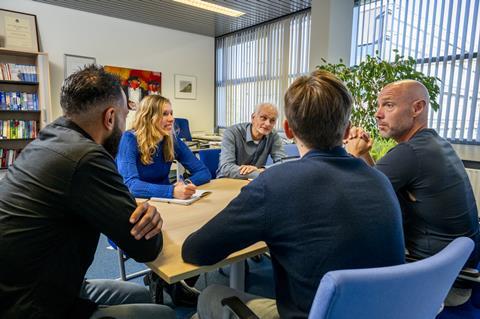
‘Following ICMS, several other institutes have been established that are similarly organized, but each has of course a different focus and flavor. But there are also connections and collaborations on overlapping topics. For example, relating to the materials transition, we have joint projects with EIRES [Eindhoven Institute for Renewable Energy Systems, ed.] and the Casimir Institute. We are continuously evaluating our positioning: what is relevant for us and with whom should we join forces?’
It all sounds very harmonious, but we all know that also within universities there is a clear pecking order. Not all disciplines and research groups are equally powerful and influential. What does that mean for the smaller groups working in a not-so-trendy niche that does not automatically fit with the focus of the ‘big boys’ like ICMS?
‘It is exactly those smaller niche groups that are absolutely essential for a university, because you simply cannot predict what will be the groundbreaking, cutting-edge research fields in twenty years from now. Just consider the internationally leading position of Eindhoven in supramolecular chemistry. That is the result from the efforts and dedication of a few pioneers that started working on this topic when almost nobody else was interested or saw the potential. Breakthroughs in science emerge bottom-up. Universities and institutes should be very careful and reluctant to try and orchestrate innovation top-down.’
Even so, the idea that universities should be managed in a more business-like manner with clear targets and key performance indicators and all that is still gaining traction.
‘Yes, I know, but what we really need are university boards that realize that a university requires a different approach than, let’s say, a cookie factory. These are completely different entities with different responsibilities and goals. At universities, we educate and train students. That is the core of our being. We foster the next generation who need to tackle the problems of the future. And to prepare them for that task, we need to perform advanced scientific research because that is the best training for students. Participating in research is their education. That requires university managers who are first and foremost engaged in education and science. But what you see now in universities and everywhere in society, is that we have way too many people who concentrate on managing “the process”. There is this unstoppable trend to fit everything into procedures and processes and it’s becoming maddening.’
And ICMS is somehow immune to this?
‘Oh yes, ICMS is truly lean and mean, it is a very small team that keeps the institute running.’
Moving to another topic: valorization of research. This has also generated plenty of discussion within academia. ICMS actively engages in partnerships with industrial parties and the formation of start-ups. Why is that important for an institute that emphasizes the importance of basic research and fundamental insights?
‘To me, this is simply our responsibility to society at large. We want to understand the basics, but we are also engineers and as such, we want to find solutions. Engineers want things to work, to be useful. And one of the ways to move from basic insights to an application is by creating start-ups. These are important links in the overall innovation track. Again, creating start-ups is not our objective, but we see it as an effective way to get our results out of the lab. The fact that we stimulate entrepreneurship is attractive for our students, because they are very much motivated to solve real-world problems, based on thorough understanding. So far, we have launched 33 start-ups and this is really appreciated by the community. For us, innovation and impact are not taboo.’
Taking into account the ongoing developments in science and technology, the many disciplines and specialization within ICMS and the larger economic, political and societal trends, how do you define the focus of the institute?
‘The core of our research is polymeric materials, that is a very strong area here in Eindhoven. Moving towards a more sustainable use of these synthetic materials requires substantial input from chemistry, not just related to production, raw materials, and recycling, but also to enable smarter materials. We increasingly demand more from the materials we use; we want them to sense their environment and adapt accordingly. That requires materials that are capable of dealing with these interfaces with the world around them. It also requires materials that are less coupled to machines and computers, but are more “programmed” to exhibit the desired behavior. Getting there requires not only chemistry, but a broad range of expertise.’
What about the broader geopolitical context? Can ‘we’ be competitive in this field?
‘If we intend to keep up and maintain the leading position we here, in Europe, still have on many fronts, then we clearly need to become less dependent on raw materials. That immediately pushes us toward developing smarter materials with “embedded” knowledge. The only way to stay in the game is to keep on pushing our knowledge. That is essential to stay ahead and remain attractive for talent from all over the world who want to work here and for companies to invest and operate here. This implies that we absolutely need to invest in science. Open innovation only happens when you stay focused on cutting-edge research; it is a way of life. It also means that we should recognize and acknowledge excellent minds - they can lift a whole field and pull others along. Within ICMS, excellency is not a tainted term.’
You seem very passionate about ICMS.
‘I am and I feel very privileged to be in this position. It is one of the best jobs in the university; it allows me to work with this group of very motivated and creative people. I’m really proud of this community.’
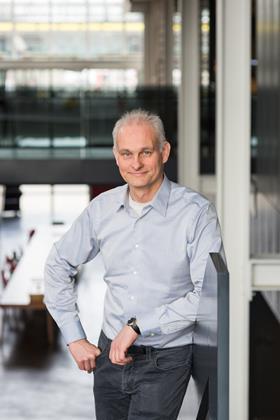
CV Jan van Hest
2024 ERC Advanced Grant (second)
2023 Member Academia Europaea
2022 Gravitation program Interactive Polymer Materials
2020 Spinoza premium
2019 Member Royal Netherlands Academy of Arts and Sciences (KNAW)
2017 Scientific director, Institute for Complex Molecular Systems
2016 Professor Bio-Organic Chemistry, Eindhoven University of Technology
2012 Gravitation program Functional Molecular Systems
2000 Full professor, Radboud University
1997-2000 DSM Research
1996-1997 Postdoc, University of Massachussetts
1996 PhD Eindhoven University of Technology
Jan van Hest is co-founder of 4 start-ups: Encapsion, FutureChemistry, Noviosense and Noviotech






Nog geen opmerkingen