


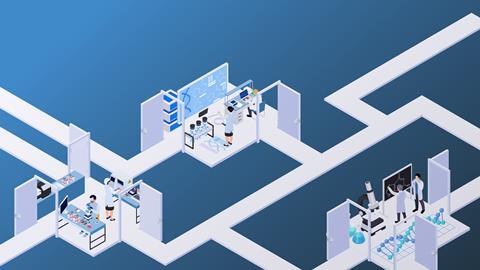
Research at the Institute for Complex Molecular Systems requires input from multiple disciplines. Therefore, knowledge exchange and collaboration are a top priority. Connecting people and multidisciplinary projects are essentials. Daily practice teaches that meetings at the central coffee machine are as important for science, as is a warm ‘we culture’.
At the start of her postdoc in the Bio-Organic Chemistry group, Nadia Erkamp put her research ideas on paper and emailed them to several ICMS principal investigators. To her positive surprise, they all provided feedback, and many suggested to schedule an appointment to discuss her plans in person. Erkamp: ‘In every job interview, people tell you there is a lot of collaboration at their institute. To what extent, is something you’ll only find out when you actually work there. I’ve worked at five other universities and in my experience ICMS is the place where ideas are shared most freely.’
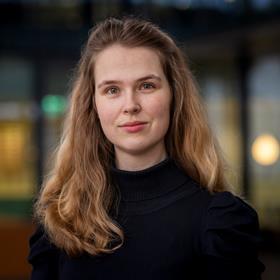
Principal investigator Diletta Giuntini, Assistant Professor Mechanics of Materials, similarly received a warm welcome by colleagues from different departments when she joined ICMS five years ago. ‘Very pleasant, especially when arriving in a totally new country and workplace.’ Giuntini also emphasizes the necessity of multidisciplinary research. ‘Current societal challenges are too complex to be addressed in a monodisciplinary way. Cooperation is a prerequisite for providing genuine solutions. Furthermore, these days research funds tend to be extremely applied and focused; there is little room for curiosity-driven basic research. By connecting people, ICMS widens the view.’
That Erkamp and Giuntini both experienced such a welcoming atmosphere is no coincidence, emphasizes ICMS managing director Monique Bruining. ‘It’s one of our top priorities to stimulate cooperation and interaction between scientists from different backgrounds. A warm welcome and a “we-culture” push the science and the community to greater heights, which in turn attracts talent.’
Bump into
ICMS stimulates cooperation in classical ways through courses, lectures and symposia for scientists with different backgrounds interested in similar or adjacent topics. The institute also stimulates interaction and collaboration by providing well-equipped shared labs, meeting rooms and office space in Ceres, the institute’s dedicated building.
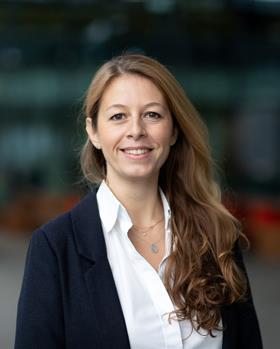
Less traditional is that PhD-students, postdocs and principal investigators (PIs), through their respective councils, organize events for their colleagues. PhD-student in Biomedical Engineering Shayan Zarin-Bal is a former member of the PhD-outreach team at ICMS that organizes informal gatherings where students can celebrate good results or share their frustrations following ‘reluctant’ experiments. Last year they also organized a podium discussion on AI & ethics. There is a yearly PhD career event with guests from industry and academia. Zarin-Bal: ‘The choice between fundamental and applied science is probably the most pressing issue for many of us.’ The largest audience assembles at the selection of the annual ICMS PhD-publication award. There is a prize for the best paper selected by ICMS-postdocs and a prize for the audience’s favourite.
Zarin-Bal is also enthusiastic about facilities at Ceres. ‘PhD students are spread around the Eindhoven campus; the nice labs and workspaces stimulate interaction. You meet colleagues you don’t bump into at your own department.’
Bottom-up ideas
The three councils come up with surprising and valuable new initiatives, says Bruining. Fun activities such as an international gingerbread baking contest, but also a platform, ICMSxMEPs, where scientists post ideas for interdisciplinary master end projects, MEPs. When at least two PI’s support an idea the project can also compete for funding. Giuntini: ‘It was an idea that sprouted from meeting colleagues from chemistry and applied physics. One of these projects has provided already some interesting primary results. I’m a material scientist and I’m always looking for interesting development opportunities for biomedical applications or high performing materials for extreme conditions.’
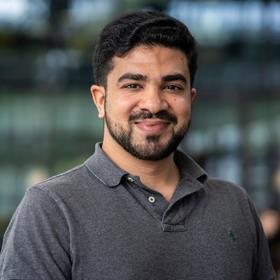
Among postdocs, the meetings with PIs from outside of the university are highly appreciated, says Erkamp who is currently on the postdoc outreach team. These events are informal, people just walk in, grab a drink and mingle with the visiting scientists. Some of the invited PI’s focus on fundamental research, others are involved in startups or collaborate a lot with industry. Erkamp: ‘This way, our postdocs can explore what would be a good next step. It can be very helpful to get feedback from people who don’t have a direct stake in your career, a kind of outside perspective.’ She thinks it is rather special that the ICMS postdocs succeed to form a tight-knit community: ‘Many postdocs spend only two years at the same research institute, much shorter that PhD students.’
Open doors
‘ICMS scientists take courses in leadership, but the outreach teams are also a way to develop such skills’, says Bruining. Did Erkamp pick up additional skills? ‘Self-organization and giving people responsibility for a piece of equipment - even a bachelor or master student - is definitely deeply ingrained here. However, I think I’m learning most about leadership here by example. People like Bert Meijer and other senior scientists who take time to discuss my ideas.’
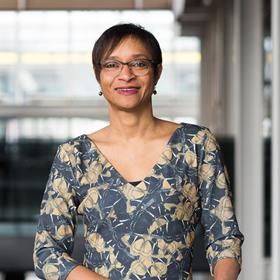
Giuntini adds that barriers and hierarchy are extremely low at ICMS. ‘You can very easily approach people of all levels of seniority; doors are literally open. It’s easy to find mentors, also outside official schemes.’ ICMS facilitates learning and professional development in your own way and pace, says Giuntini. ‘You meet scientific directors easily, but also the management. There are lots of diverse examples to learn from.’
Zarin-Bal agrees: ‘You easily meet people here. I know the names and faces of at least three PI’s who I can turn to when I encounter a problem. Also, in disciplines outside my own, such as mathematics or imaging.’ The PhD student also feels that the relaxed attitude towards hierarchy stimulates young scientists to put forward their ‘craziest’ ideas. ‘You feel that everybody is excited about science. The multidisciplinary approach of ICMS is not just words, because we know the science will work only through real interaction.’




Nog geen opmerkingen