


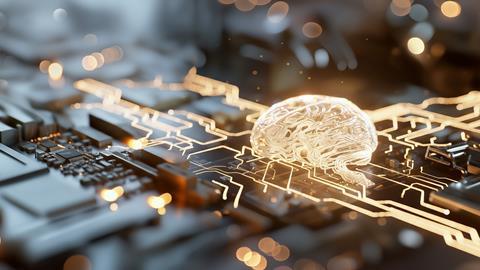
When it comes the bio-inspired materials for computing, the possibilities are endless. From DNA strands that encrypt sensitive data to conductive polymers that combine computing power and memory on a single chip — outside of the established computer industry, exciting things are happening. ICMS members Tom de Greef and Yoeri van de Burgt are on the forefront of developing such new materials for data storage and processing.
Transistors continue to shrink; electronics are computing faster and faster, and AI is becoming ever more impressive. Yet behind the screens , considerable challenges are lurking. ‘We are facing an enormous data problem,’ says Tom de Greef, professor of synthetic biology at Eindhoven University of Technology. ‘We generate so much data that in a few years’ time, we won’t be able to store it all.’
Computer chips also need to be renewed, adds Yoeri van de Burgt, associate professor of neuromorphic engineering at the same university: ‘For large AI systems such as ChatGPT to work efficiently and in an energy-efficient way, they need to calculate as many training values as possible in parallel. But current silicon chips are not all designed for that task.’
‘Instead of storing binary code, we encode the information in synthetically created DNA’
Tom de Greef
Both researchers are working on new materials that can overcome the limitations that the computer industry is facing. De Greef, for example, is developing techniques that allow data storage in DNA, which has a longer shelf life and takes up less space. Van de Burgt, for his part, is working on conductive polymers to make AI chips more efficient by mimicking the way our brain handles data processing and storage. According to Van de Burgt, it is not about ousting current electronics. ‘There are plenty of other unique applications for these materials.’
DNA microcapsules
We produce approximately 147 billion terabytes of data per year (and this amount continues to grow). Around 60% of this massive stream is ‘cold’ data: data that we do not actively use, but which we still store. ‘Currently, we mainly use magnetic tapes for storage,’ says De Greef. ‘The problem is that these tapes are toxic and have a limited lifespan of twenty years.’
Additionally, even though these micrometer-scale tapes are small, they still take up far more space than the nanometer dimensions of DNA. De Greef: ‘Instead of storing zeros and ones as binary code, we encode the information in synthetically created DNA. We do this using the base pairs AT and CG. This way, in a dark environment at room temperature, information can be stored for up to two thousand years.’
‘Current silicon chips are not all designed for that task’
Yoeri van de Burgt
A major challenge of this DNA-based technique concerns reading the stored information in a reliable manner. Biomedical engineer Bas Bögels, who last year completed his PhD research in De Greef’s research group, tackled this topic. Using proteins and polymers, he developed microcapsules that enclose an individual DNA ‘file’ (consisting of multiple DNA-strands), which prevents different files from becoming mixed up during the reading process. According to Bögels, DNA data storage will become increasingly popular. ‘Some start-ups already offer DNA storage services,’ he says. ‘But I think it will take another ten years or so before it can be applied on a large scale.’
Synaptic chip
Nearby on campus, Van de Burgt is drawing inspiration from the brain to develop more efficient chips for AI systems. He works with a special type of conductive polymer called PEDOT:PSS (poly(3,4-ethylenedioxythiophene):poly(styrene sulfonate)). Similar to how the synapses in our brain adapt to a signal, these polymers can adjust and remember their resistance. ‘In this way, the organic polymers bring together computation and memory in a system known as in-memory computing, just like our brain does,’ says Van de Burgt. ‘This differs from conventional computers, where the computing part — the processor — and the memory are separated.’
‘We have added disruptive molecules to the mixture that block the reading of the files’
Tom de Greef
To train the neural networks of AI systems as efficiently as possible, it is important that the conductivity of the underlying hardware can be quickly and effectively adjusted. ‘Most in-memory computing systems are not yet very good at that,’ says Van de Burgt, ‘but our polymers can absorb individual ions and then compensate for changes in charge by adjusting their resistance with extreme precision. This makes them ideal for training neural networks locally on a chip.”
Hacking
There are still a few hurdles to be scaled, before we will see usage of these materials on a large(r) scale, says Bögels. ‘For example, the costs of DNA synthesis for data storage need to be lowered.’ De Greef adds: ‘Currently, producing one megabyte of DNA would cost seven hundred euros. That is not profitable.’ He estimates that it will take another ten to fifteen years before the cost of DNA storage has fallen enough to make it viable.
In the meantime, De Greef has already spotted another potential application: DNA encryption. While digital encryption can be hacked, physical DNA data can only be accessed by reading it on the spot, making it in theory much more secure. This is why De Greef and his team are now focusing on ways to encrypt information in DNA. ‘Our method revolves around a unique DNA key: a strand of about fifty bases in a specific sequence that must be added to the mixture to enable reading of the DNA,’ says De Greef. ‘We have added disruptive molecules to the mixture that block the reading of the files, and only the key can capture these molecules.’
‘Our organic polymers bring together computation and memory, just like our brain does’
Yoeri van de Burgt
Van de Burgt is also realistic about the possible applications of his system. ‘Training large-scale neural networks with millions of parameters is simply not going to happen with our polymers. The stability of our materials is not good enough for that, and in terms of scalability, we cannot compete with the current industry.’ This is why he is considering a different approach: smart, personalized biosensors for biomedical applications. ‘The niche of organic materials is that they are biologically compatible and flexible. Our polymers, for instance, absorb ions, which the body uses constantly to send signals. That is why we are now focusing on developing small AI systems that can process information locally, train themselves, and ultimately perform an action such as administering medicines.’
He points to diabetes management as an example. ‘Instead of measuring your blood values to determine when to inject insulin, an AI chip can be trained to recognise personal patterns in an individual patient. This enables more accurate predictions of the need for insulin.’ According to Van de Burgt, the possibilities don’t stop there. ‘There is so much information to be found in the body and the environment. With local AI systems, we can utilise this information without the need for heavy computers or the cloud.’







Nog geen opmerkingen