





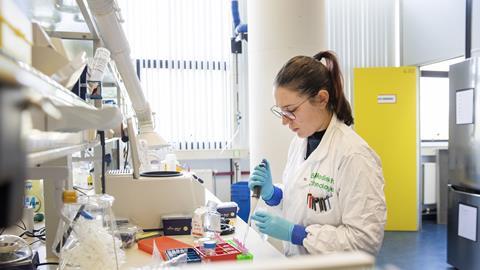
The master’s program of Biomedical Engineering at Eindhoven University of Technology is a combination of technology, chemistry and human biology. In this program, you will learn how to solve biomedical problems using a technological perspective, i.e. applying engineering principles to biomedical problems and developing new medical technologies. Various disciplines merge in the Biomedical Engineering Master’s program: physics, chemistry, mathematics, and medical science.
Specialisations
There is a huge spectrum of research themes within the master’s program. They fall within three clusters: Chemical Biology, Regenerative Engineering & Materials and Biomedical Imaging & Modelling. You choose a research group in one of these clusters as your specialisation.
In the Chemical Biology cluster, you can think of topics like developing a nanomotor to deliver medicine to the right place in the body, engineering luminescent biosensors to improve viral diagnostics or creating biomaterials to grow and restore diseased tissues. Check the program page under Degree structure for the full list of research groups you can choose from. You can also check our department page for more information.
Program structure
The master’s program is two years. The first year of the program consists of specialization electives, free space and an external internship. The specialisation electives are chosen in consultation with your mentor, a researcher from the group that you specialise in. The so called ‘externship’ is often done at a research institution abroad, like the US or Australia. It could also be done at a Dutch company. Most importantly, it is experience outside of our department.
The second year could either by devoted entirely to the graduation project (research profile), or for three quarters (45 ECTS), leaving another 15 ECTS for more free electives (free profile). The graduation project is done in the department, at your research group. In the free space, you can choose to broaden or deepen your knowledge, by following a course at another department for example. There is plenty to choose from.
After graduation
With your knowledge, skills and your methods of doing research, you have the perfect background to find a job as a biomedical engineer. Demand for biomedical engineers is high; the role of technology within healthcare is ever increasing.
You can find work in business, as a quality engineer, project manager, consultant or product developer. This could be at for example a pharmaceutical or biotech company. You can also decide to continue with scientific research and pursue a doctorate (PhD) at TU/e, another university or an academic hospital. If you would like to discover how biomedical technologies can best be incorporated in clinical practice, consider the EngD (Engineering Doctorate) post-graduate program to become a Qualified Medical Engineer.
Admission and premaster
For students that don’t have a Biomedical Engineering bachelor, admission could be possible with a premaster, depending on the courses in your prior education. There is not one fixed premaster, it is tailored to you individually. Interested but unsure whether your background would fit? Please come find us at the Next Step Master Day. Moreover, you can get in touch with our academic advisor via BME.admission@tue.nl.