


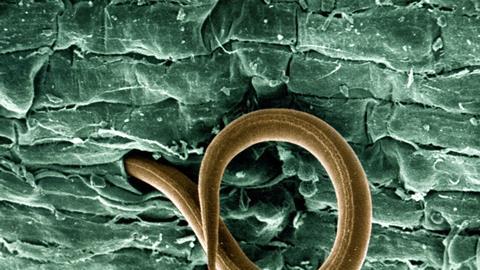
A group of international researchers has demonstrated that the root-knot nematode species Meloidogyne incognita employs ingenious methods to locate its host plant. In Nature Plants, the researchers report that they do this by picking up chemical signals from the microbiome cultivated by the plant.
Root-knot nematodes are parasites that must search for a host immediately after hatching from their eggs. They can only feed on the plant once they have settled in the tips of its roots. For crops, this infection results in significant yield losses. However, it has long been unclear how these nematodes manage to find their host.
This new study examines how indole-derived benzoxazinoids — molecules that protect against insects — influence the interaction between maize plants and root-knot nematodes. To investigate this, the researchers used mutants that produced either no benzoxazinoids or an increased amount. Interestingly, fewer nematodes infected the plants without benzoxazinoids. ‘But the most interesting finding was that plants producing benzoxazinoids remained uninfected when grown in sterile soil’, says study author Jose Lozano-Torres of Wageningen University & Research.
‘That gave us the idea that this might be a tripartite interaction’, he continues. That is, an interaction between three organisms – the plant, its soil microbiome, and the nematodes – in which the microbiome attracts the nematodes. This theory was confirmed when it was found that maize plants that secreted benzoxazinoids had higher levels of Pseudomonas and Citrobacter bacteria around their roots than plants without benzoxazinoids. It transpired that the nematodes responded to the volatile substances produced by these bacteria. Root-knot nematodes were particularly attracted to 1-undecanol, 2-phenylethanol, 1-tridecene, 2-undecanone, 2-tridecanone, dimethyl disulphide, 2-heptanone and 2-nonanone. Using 1-undecanol and 2-phenylethanol, the researchers then identified three genes for the necessary odour receptors.
Not unique
‘It’s extremely interesting research and a well-written paper’, says Harro Bouwmeester, a professor of chemical communication in plants at the University of Amsterdam who was not involved in the study. He sees many similarities with his own research on nematodes in tomatoes and potatoes, as well as with the microbiome of maize.
In Bouwmeester’s research, he often found that parasites use plant signalling substances to their own advantage. Take, for example, the parasitic plant Striga. This parasite uses the strigolactones secreted by the plant to find a host. These plant hormones are important for attracting mycorrhizal fungi that help the plant obtain nutrients, among other things. Another substance that attracts parasites is solanoeclepin A, which attracts potato cyst nematodes in this case. Potatoes secrete this substance to attract beneficial microorganisms. ‘I see this as a biological principle whereby substances essential to plants for signalling are misused by pathogens’, says Bouwmeester.
‘In their discussion, the authors seem to overlook the biological importance of benzoxazinoids for the plant’, he adds. Like strigalactones and eclepines, benzoxazinoids are useful to the plant. With their antimicrobial effect, they keep pathogens under control. Volatile substances produced by Pseudomonas and Citrobacter bacteria, such as 1-undecanol, also promote plant growth. In addition, these bacteria activate the plants’ defences against herbivorous insects.
Root knot nematode management
Such an important signalling substance cannot simply be removed. ‘Nevertheless, it is important for breeders to realise that benzoxazinoids can have both positive and negative influences on plants’, says Lozano-Torres. He also considers the option of trap crops, which protect other crops by cultivating bacteria that attract root-knot nematodes. However, the challenge here is to prevent plants from producing so many antimicrobial benzoxazinoids that all microbes die.
Another option is soil, or rather microbiome, management. As the nematodes are attracted to volatile substances produced by a specific group of bacteria, it could be beneficial to cultivate a microbiome that does not produce these substances. ‘But the question then is whether you can replace the microbes that attract the parasites with bacteria that perform the same function in the plant without emitting those volatile substances’, says Bouwmeester.
This is why the most promising leads may be the odour receptors identified in root-knot nematodes. These receptors could be targeted by substances that disrupt the nematodes’ ability to orient themselves, causing the root-knot nematode to die of exhaustion before finding a host. However, until then, the nematodes are likely to outsmart the plants.
Wu, Z. et al. (2026). Nat. Plants, DOI: 10.1038/s41477-025-02205-4








_penetrates_a_tomato_root_-_USDA-ARS.jpg)
Nog geen opmerkingen