


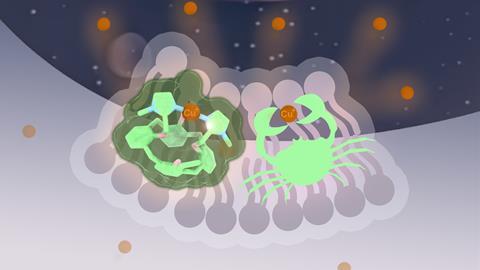
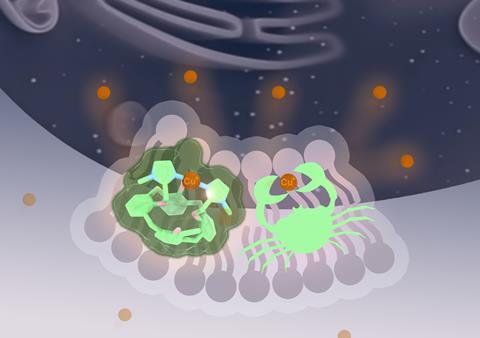
For the first time, it has been possible to transport Cu⁺ through cell membranes using a small biomimetic molecule, without the aid of proteins. According to an international team in JACS, this completely unexpected development has the potential to become a potent anti-cancer strategy.
Copper ions have a dual role in cells: they are vital for cell growth when bound to proteins and enzymes, but can be life-threatening when they occur freely in the cell. Therefore, the balance and transport of Cu⁺ must be carefully regulated. ‘In cells, this is regulated by proteins that conduct ions through membranes’, explains Hennie Valkenier, FNRS Research Associate at the Université Libre de Bruxelles (ULB). ‘As chemists, we ask the question: can this also be done with small molecules?’
An earlier article discussed the transport of bicarbonate, and chloride transport has also been extensively researched. ‘But I really enjoy trying to transport ions with small molecules for which this has not yet been successful’, she continues. It was this that led her to take a closer look at Cu⁺ transport. ‘Originally, the idea was to use copper transport to combat rare genetic diseases such as Wilson’s disease and Menkes disease. In these diseases, there is sometimes too much and sometimes too little copper, with many unpleasant consequences.’
Modified yeast cells
The master’s student who brought the project to a proof of principle, Nathan Renier, was keen to continue with it in his PhD. ‘We contacted colleagues in Grenoble to see if the molecules we had designed worked in liver cells’, says Valkenier. ‘To our surprise, we found that our molecules, in combination with copper, were highly toxic to cancer cells and were more effective than many current anti-cancer drugs, even against resistant forms of glioblastoma and lung cancer.’ They applied for a patent almost immediately and took the opportunity to develop this further.
This was essential, as Valkenier’s group were the first to demonstrate Cu⁺ transport through lipid membranes, which required considerable effort. ‘After the membranes, we tested our molecules in modified yeast cells that lacked copper transport proteins’, explains Valkenier. ‘Without our molecules, there was no copper transport and therefore no cell growth. With our molecules, however, there was.’
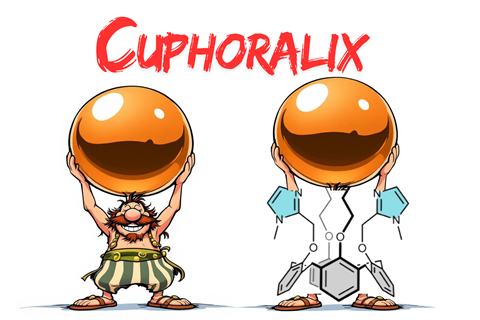
The molecules were designed with biological activity in mind. ‘We drew inspiration from the way two histidine amino acids bind copper’, says Valkenier. ‘We placed those imidazole groups on a ring-shaped molecule, a calix[4]arene.’ The most effective variant was named Cuphoralix, a combination of the words ‘copper’ (Cu+), ‘ionophore’ and ‘calix[4]arene’, and a subtle nod to the well-known comic book characters Asterix and Obelix.
Experience
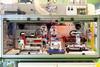
Valkenier and her colleagues recently travelled to Grenoble again to use the synchrotron, a European research facility. Valkenier: ‘There, you can visualise things that would normally be impossible to see. Using X-rays, you can observe the fluorescence of specific elements. You can see exactly where the copper ions are located in organelles, which is very impressive.’
But that wasn’t the only impressive thing — research at the synchrotron itself is quite an experience, too. It is a circular building with a circumference of about one kilometre. At its centre is a particle accelerator whose electrons are deflected to produce X-rays. ‘At specific locations, these powerful beams emerge from the ring in what are known as beamlines. Each beamline has a state-of-the-art laboratory where teams from all over Europe work day and night’, says Valkenier. ‘You can rent time there and stay overnight. Fortunately, measuring copper in cells takes a long time, so we were able to set the equipment to run at 11 p.m. and get a few hours of sleep. But there is so much going on and a continual flow of work, and the people who come here are really passionate about science.’
Valkenier and her colleagues studied copper distribution in liver cells (hepatocytes). The general rule is that too little copper means the cells won’t grow, while too much copper is toxic. ‘The liver cells can handle a little excess copper; they store it in endolysosomes’, says Valkenier. ‘But if you add a small amount of our molecules, they move the copper from the endolysosomes to the cytoplasm, causing the concentration to suddenly become too high and the cells to die.’
What struck Valkenier was the precision required in terms of the lipophilicity of the molecules. ‘It’s incredibly precise; there’s only a very small range within which you have to operate to observe anti-cancer activity.’ Cuphoralix is therefore not water-soluble and cannot be injected. ‘We are now working with various colleagues on a formula that will make the molecules water-soluble and target cancer cells. That formula should lead to the first animal tests.’
Twenty authors
‘This was one of those projects where we had to collaborate with people from many different disciplines’, says Valkenier. ‘We collaborated with supramolecular and organic chemists, the synchrotron in Grenoble, copper cell experts, cancer and treatment specialists, and yeast cell researchers. It was great fun to work with so many people.’
She wants to emphasise the interdisciplinary nature of the work. ‘If we hadn’t worked together, we would never have made these discoveries. We designed the molecules with colleagues in Brussels, but we didn’t expect them to ever be valuable in the fight against cancer.’ The project began with a single master’s student working on his thesis, motivated by the vague idea that it might work. ‘That led to an eight-year project from which several doctoral students graduated, and which a new generation is already continuing.’ Valkenier concludes: ‘It’s wonderful how one such master’s project can snowball into something much bigger.’
Renier, N. et al. (2025) JACS 148(1), DOI: 10.1021/jacs.5c15335






Nog geen opmerkingen