


A new tool enables researchers to easily document exactly how they have prepared and synthesised metal-organic frameworks, allowing their peers to replicate results more consistently. The EU4MOFs consortium published the open-access tool in Advanced Materials.
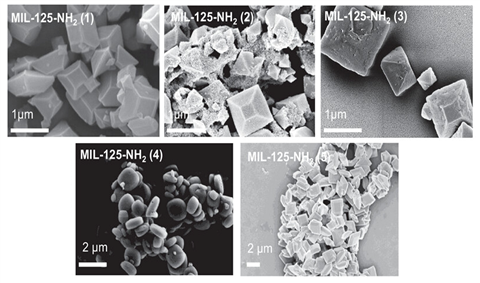
MOFs have gained widespread attention, especially since the 2025 Nobel Prize in Chemistry. Despite decades of research, there are significant challenges in the reproducibility of MOFs. ‘The synthesis is very sensitive to tiny changes’, says Bettina Baumgartner, assistant professor at the Homogeneous Catalysis Group at the University of Amsterdam. ‘Differences in humidity, a different supplier of precursors or temperature can all influence the outcome. Some are very delicate.’
The reason behind these variations isn’t yet fully understood. ‘We are just beginning to understand that many conditions influence the synthesis’, Baumgartner continues. Some papers go into several of these points, such as the influence of the water content of precursors stored in different places on MOF production.
Questionnaire
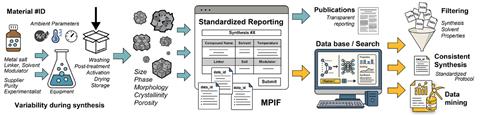
Although the reasons are still unknown, Baumgartner and her colleagues from the EU4MOFs consortium have now published an article presenting a Material Preparation Information File (MPIF) to facilitate consistent reporting of the synthesis process. ‘Most research groups document their MOF recipe, emphasising what they deem important, but these details can vary significantly’, explains Baumgartner. ‘With MPIF, we created an online tool that standardises the reporting of MOF synthesis. You can fill in the tool like a questionnaire, which we made as detailed as possible, covering as many aspects as we could think of.’
Once you have completed the MPIF form, you will have created a simple .txt file containing all the important details that can easily be attached to your publication. ‘MPIF files are similar to CIF files for crystallography. When reporting a new crystal structure, there is an automated way to do so. MPIF strives to be a similar tool.’ The files are both human- and machine-readable.
Awareness
Currently, the consortium is conducting a round-robin study in which they provided research groups with different recipes based on MPIF files to determine whether reproduction is more consistent. They are currently analysing the results. ‘When we presented the MPIF at the last EuroMOF conference, our peers were very enthusiastic’, says Baumgartner. ‘It’s not just limited to MOFs; you could use it for other porous materials as well, such as COFs [covalent organic frameworks, ed.] and zeolites. If this sparks inspiration for applications in other fields, that would be great too!’
The main goal now is to encourage people outside the EU4MOFs consortium to use the MPIF system. Baumgartner: ‘We’re discussing this issue with journal editors and proposing to make this style of reporting mandatory. If everyone has to do it, then it will become a widespread method very soon. It would also be logical, as other fields have reporting requirements too.’ The consortium has made every effort to ensure that filling in the details online is straightforward. ‘We believe this will greatly help the field, so we’re now aiming to increase awareness of the tool.’
Another step that Baumgartner and her colleagues are taking is to standardise the characterisation of MOFs. ‘This is an ongoing project’, says Baumgartner. ‘We’re currently comparing data from all over Europe to see how we can standardise it.’ MOFs are amazing materials, but being unable to reproduce the synthesis correctly because a tiny detail was left out is really frustrating. ‘With MPIF, hopefully this will change for the better.’
MOFcast
The first author of the Advanced Materials paper, Ocean Cheung, has started a podcast all about MOFs called the MOFcast. In September, Cheung, Dariusz Matoga and Baumgartner recorded an episode about MPIF: how it came about, and its benefits. You can find the podcast on Spotify and various other platforms.









Nog geen opmerkingen