


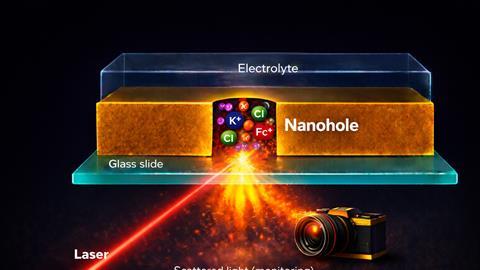
Scientists at Utrecht University have developed an optical method for visualising electrochemical processes at the nanoscale. The technique uses nanogaps and scattered light to track reactions in attolitre volumes without labelling, as the researchers demonstrate in PNAS.
During electrolysis, electrochemical reactions, such as the production of hydrogen, occur within a few nanometres of the electrodes. Conventional methods are insufficient to map these reactions with sufficient resolution. For instance, electron microscopes require an inconveniently high vacuum, while spectroscopic techniques are too slow to track the rapid reactions. This makes it difficult to monitor electrochemical processes on a small scale.
However, researchers at Utrecht University, in collaboration with colleagues from the East China University of Science and Technology, have now developed a new technique that enables electrochemical reactions to be monitored at the nanoscale. Opto-Iontronic Microscopy uses nanogaps (100 nm³) in which the reactions occur. By shining light on these holes and measuring the scattered light, the technique provides information about how reactions proceed in attolitre volumes. Zhu Zhang, a physicist at Utrecht University and the study’s first author: ‘With our technique, we can monitor local electrochemical reactions under realistic working conditions.’
Nanogaps
For their electrode, the researchers, led by nanophotonics expert Sanli Faez, deposited evaporated gold onto a substrate. There, it formed a wafer-thin layer 100 nanometres thick. ‘Using an ion beam, we ‘drilled’ holes in this gold layer on the nanoscale’, says Zhang. ‘We then added a liquid electrolysis sample. By applying a potential to the electrode, electrochemical reactions take place in the nanogaps.’
To monitor these reactions, the researchers placed the setup under a microscope and shone a laser onto the nanogaps. The holes scatter the light depending on the reaction taking place inside them. Zhang continues, ‘This is because a change in the local ion concentration causes a different refractive index of the nanogap, which changes the scattering of the light.’ We capture this scattered light with the microscope lens and determine the change in intensity. From this, we can deduce the local reaction in the hole.’
Poisson–Nernst–Planck–Butler–Volmer
The researchers tested their method in real time using a model electrochemical reaction: the ferrocenedi-methanol redox reaction. They validated their results against the predictions of a theoretical model for electrochemical processes (the Poisson–Nernst–Planck–Butler–Volmer model), which provided insights into the contribution of changes in ion concentration to the optical contrast.
According to Zhang, the biggest challenge was increasing the signal-to-noise ratio. ‘The measured signal is very weak. We tried many different techniques to amplify it. Ultimately, the trick was to look not at the change in intensity of the scattered light over time, but at the amplitude of the oscillation of the scattered light intensity. This produced a much more precise signal and made the technique a hundred times faster.’
The researchers demonstrated that their method can perform measurements in milliseconds. This makes the technique suitable for mapping electrochemical activity in limited geometries with high sensitivity and without labelling. For example, it could be used in the design of catalysts or in environmental electrochemistry.
Bubbles
They are currently using their technique to visualise hydrogen production and ion transport at the nanoscale. To achieve this, they created new nanogaps made of platinum rather than gold, as platinum is a more effective catalyst for hydrogen production. ‘Electrolysis reduces water to small bubbles of hydrogen’, says Zhang. ‘In our setup, we are now studying whether these bubbles form inside or outside the nanogaps. This is important because the electrodes and membranes used for electrolysis are porous. If we understand how hydrogen bubbles form better, we can optimise their design.’
According to Zhang, this technique can also be used to optimise circular batteries. For example, they can create nanogaps in lithium to observe the reactions that occur when the electrode is charged and discharged. Our technique can be applied to many different electrochemical reactions.’






Nog geen opmerkingen