


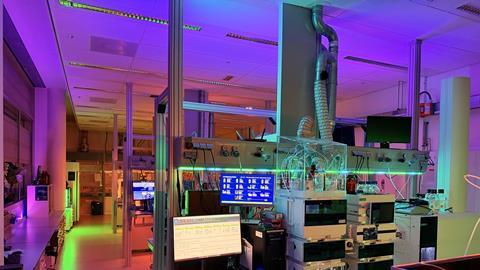
Agilent Technologies, an instrument manufacturer, and the Chemometrics and Advanced Separations Team (CAST) at the Van ‘t Hoff Institute for Molecular Sciences (HIMS) at the University of Amsterdam are joining forces to gain more insight into polymers in an automated laboratory. ‘For us, it’s a golden opportunity to be able to work on method development with this advanced equipment.’
‘Although times have changed, we originally started out as a polymer analysis group led by Peter Schoenmakers for many years’, says Bob Pirok, associate professor at the University of Amsterdam and CAST group leader. ‘This has enabled us to build an extensive network of collaborations with the polymer industry.’
It is through this network that Agilent Technologies, one of the world’s largest companies in the field of scientific instrumentation, approached Pirok. ‘They have all kinds of interesting “workhorses” for which they want to know how they can contribute to polymer analysis’, Pirok continues. ‘Polymers present a challenge to mass spectrometry because very large molecules tend not to ionise well and are difficult to study.’ Agilent’s devices have various functions and ionisation sources that Pirok’s group would like to experiment with.
Pressure
In general, the polymer industry is under pressure from geopolitical fluctuations, tariff wars, and, not unimportantly, competition from China, which produces much cheaper polymers. ‘In Europe, there is also fairly progressive environmental legislation, which is not necessarily a bad thing, but it does put pressure on companies’, says Pirok. There is a great need for robust methods to better understand polymers and gain a competitive advantage in terms of knowledge. ‘As a manufacturer, it is important to come up with solutions. Agilent wants to demonstrate the potential of its equipment.’
‘Companies contribute technology and expertise, while academic freedom is preserved.’
‘For us, it’s a golden opportunity to work on method development with this advanced equipment and see how our AI systems can get more out of it’, Pirok continues. ‘We help with publications, demonstrate what is possible and indicate which methods are useful for the polymer industry.’ According to Pirok, Agilent is not involved in the content of the research line. ‘This means we don’t have to give up our scientific independence.’ He believes that this collaboration is a good example of how academia and industry can work together. ‘Companies contribute technology and expertise, while academic freedom is preserved. We are therefore always open to this type of collaboration.’
Agilent’s Revident LC/Q-TOF system has now been integrated into the AutoLC network in Pirok’s laboratory, which is partly powered by AI and connected to various systems. ‘Our AI can use all devices without human assistance’, explains the associate professor.
‘It is programmed in such a way that it can pick out interesting peaks from the data and then analyse them on other devices.’
AutoLC, which is not limited to LC but can also be applied to other separation techniques, aims to make the analyst’s work easier. ‘We submit the chromatograms from our standard measurements to AI. After the analysis, it can try other methods to achieve a better separation.’ Polymers in particular normally involve a lot of trial and error, but AI can provide a good starting point from which to continue working.
‘More complex techniques such as 2D LC/MS-MS then also come within reach’, says Pirok. ‘It usually takes far too much time to get started yourself, but you can simply let the machine run day and night.’ When there are no people in the lab, it is important to know exactly what the machine is doing. The lab is therefore equipped with all kinds of coloured LEDs and control panels that allow you to monitor and correct the AutoLC remotely. ‘You have to keep a close eye on it because AI has almost destroyed some systems already.’
AI Winter
Humans will therefore always be important, according to Pirok. ‘Only humans can assess the value of a number produced by a method, so the responsibility will always remain with humans, never AI.’ Pirok does not believe that day-to-day operations will change fundamentally. ‘But it will change for more complex techniques, even in less advanced laboratories. If you can automate them, you can more easily use more sophisticated features. Take 2D LC, for example. It has been around for thirty years, yet it is still hardly used, despite everyone knowing that it can provide orders of magnitude more information. So the effort and costs need to be reduced, and automation can help with that.’
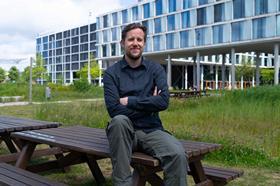
Pirok also wants to emphasise that AI can quickly become unjustified hype. ‘Yes, there is a lot of potential for AI in automation, but we mustn’t end up in another ‘AI winter’. This has happened time and again in the history of AI. In the 1950s, chess was solved using AI, and people started dreaming big, while scientists warned that many of these dreams might not yet be achievable.’ A lot of money was made available, but little was achieved. The funding was withdrawn, and it remained that way until the 1970s. This story repeated itself several times, and Pirok fears that another AI winter is coming precisely because society as a whole is hooked, despite there still being fundamental limitations. ‘I think companies are too quick to rush into AI for fear of missing out. In my view, it is important to be cautious while not overlooking the real opportunities.’







Nog geen opmerkingen