


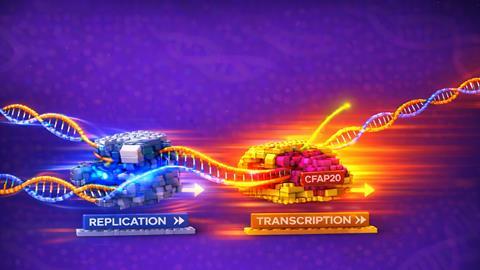
For DNA replication and transcription, different proteins move along DNA strands, each with its own task and speed. Researchers at Leiden University Medical Centre (LUMC) have now shown in the journal Nature that the protein CFAP20 acts as a traffic controller, preventing collisions.
Various proteins, known as polymerases, travel along the DNA ‘rails’, with some copying strands and others creating protein recipes. They travel at different speeds along the base pairs. This means they can encounter each other, for example, at the start of a gene. There, the transcription protein RNA polymerase II (RNAPII) often gets off to a slow start, meaning that the replication protein could collide with it.
Researchers at LUMC have now discovered that CFAP20 plays an important role in DNA traffic. While it is known that CFAP20 is part of cilia, which are tiny hairs on the surface of cells, its function in the cell nucleus was completely unexpected. Molecular biologist and transcription expert Martijn Luijsterburg led the research at the LUMC: ‘We have discovered that replication often starts just before an active gene, which means that replication and transcription are closely linked. CFAP20 ensures that RNAPII moves away quickly enough to prevent the replication machine from crashing into it.’
Large-scale screening
Luijsterburg explains that the research began with the question of how the cell keeps replication and transcription separate. In search of the proteins involved, the researchers carried out CRISPR screenings. ‘Using the CRISPR-Cas9 system, we switched off genes on a large scale. We switched off all 20,000 genes in the human genome individually. This resulted in a large pool of cells, with one gene switched off in each cell.’
The researchers then exposed each of these cells to one of two different molecules: one that partially blocked transcription, and the other that partially blocked replication. ‘The molecules caused a fraction of the polymerases to jam. First, we jammed RNA polymerases in one screening and DNA polymerases in another. We then studied which cells died as a result. The intersection of the two screens revealed a handful of genes necessary for survival following both treatments. This led us to CFAP20, which was at the intersection of the two screens.’
Accelerating transcription
The researchers then studied the influence of CFAP20 on the speed at which RNAPII transcribes DNA. To achieve this, they labelled RNA that was still being actively produced by RNAPII. They then fragmented these chains, removed them from the cell, and analysed their sequence. This showed how far the RNA had been transcribed within the gene. The researchers also used a compound called DRB, which causes RNAPII to pause at the start of a gene without initiating transcription. As soon as the researchers washed away the DRB, transcription started simultaneously in all cells. Luijsterburg explained, ‘By labelling the RNA at different times, we could see how quickly RNAPII produces mRNA. We observed that when we switched off CFAP20, transcription at the start of genes was approximately half the normal speed.’
The team also investigated how switching off CFAP20 affected the splitting of DNA strands during replication. ‘Of the approximately five thousand sites on the DNA where replication can begin, we observed replication stalling at half of them. This was because RNAPII was moving far too slowly at the start of the gene.’
CFAP20 in tumours
The fact that CFAP20 plays such an important role in the regulation of transcription and replication suggests that it may also play a role in the progression of cancer. For this reason, the researchers investigated the presence of CFAP20 in different tumour types. Luijsterburg: ‘The numbers are still fairly small, but we found a mutation in seventeen different tumour tissues from patients ranging from breast to cervical cancer in a database, which proved to be essential for the transcription function of CFAP20.’ Our hypothesis is therefore that CFAP20 may be the Achilles heel of tumour cells. If we can devise a therapy for this, it could be hugely beneficial.’
The next step for the researchers is to further unravel the precise functioning of CFAP20. ‘One question we want to answer is where this specificity comes from. It appears that CFAP20 binds with RNAPII at the beginning of a gene. Why does it do that there and not, for example, in the middle of a gene? We now want to investigate this in vitro with purified proteins.’
The transcription side
Jurgen Marteijn, an expert in the field of DNA damage and transcription at Erasmus MC, appreciates the research: ‘For a long time, these kinds of transcription-replication conflicts in DNA have mainly been studied from the perspective of what happens when the replication machinery malfunctions. It is only recently that much more attention has been paid to the transcription side of the story. From that point of view, the new factor demonstrated by this study is very interesting.’
Marteijn sees the role of CFAP20 as an important additional piece in the puzzle of the many processes that protect our DNA. ‘This study is a very good example of important fundamental research that may offer a new clinical starting point. Whether CFAP20 can actually be an Achilles heel for certain types of cancer remains to be seen in further research.’






Nog geen opmerkingen