


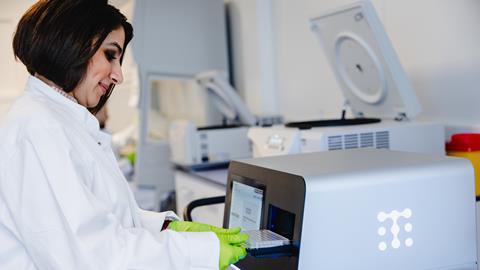
Introducing large molecules into a cell can be done using brute force, but this often causes damage to the cell. The Ghent-based start-up Trince focuses on photoporation, a unique transfection method that not only leaves cells in good health but is also suitable for high-throughput applications.
Whether you want to test a drug using a realistic disease model or create a therapeutic cell, transfection is almost unavoidable. This process involves introducing genetic material into the cell to modify it. However, the three classic methods—viral vectors, chemical reagents, or electroporation—have their limitations. ‘The first two methods are expensive and not widely applicable, and the latter literally tears the cells open using an electric field to get molecules inside’, says Kevin Braeckmans, head of the biophotonics group at Ghent University and co-founder and CTO of Ghent University spin-off Trince. ‘Although electroporation is an efficient and widely applicable transfection method, it causes considerable toxicity to the cell.’ There is therefore a need for a ‘gentler’ technology that offers the same advantages as electroporation. According to Trince — TRansfer INto CElls — photoporation is the answer.
‘ Our technology is highly suitable for upscaling and automation, and therefore also for high-throughput screening.’
Kevin Braeckmans
Local forces
In photoporation, you first add light-sensitive nanoparticles to the cell culture. ‘These bind to the surface of the cells’, explains Braeckmans. ‘We then shine laser light of very specific frequencies onto them, which activates the particles. The heat and mechanical forces generated cause small pores to form at the site where they are bound. The molecules can then enter the cells through these pores and do their work there.’
Because the forces act very locally, the impact on the cell is minimal, according to Braeckmans. The technique also works with all possible cell types. ‘And last but not least, our technique is very suitable for upscaling and automation, and therefore also for high-throughput screening.’
The first striking application of photoporation is therefore drug screening. ‘Soon after we developed the technique in my lab at Ghent University in 2012, we received interest from the biomedical research field and the pharmaceutical industry. Many companies in this sector have a large library of biomolecules, but testing their efficacy on realistic diseased cells quickly, efficiently, and in large quantities remains difficult. With our technology, they could obtain significant efficiency gains.’
‘A large part of our customer base is in the US.’
Philip Mathuis
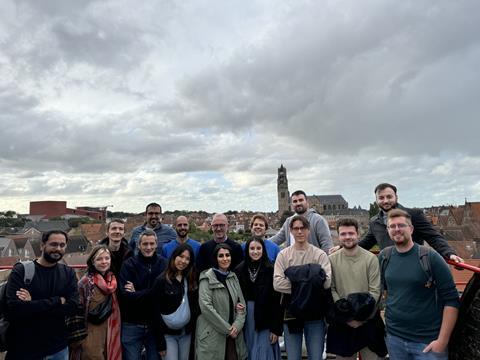
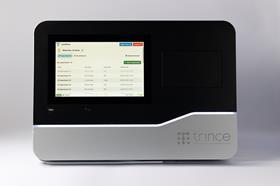
A prototype followed in 2018, after which Braeckmans sought a partner with entrepreneurial experience during the COVID-19 pandemic in 2020. He found this partner in Philip Mathuis, with whom he founded Trince in December 2021. ‘Last year was our first commercial year, in which we sold no fewer than ten of our Lumipore™ devices’, says a proud Mathuis, now CEO of Trince.
Fighting cancer
There are also success stories involving the machines sold, Mathuis continues. ‘For example, a large pharmaceutical company has informed us that, thanks to our photoporation technology, they have been able to identify new active molecules, for which they have been able to apply for a patent.’
This year, the 15-strong but rapidly growing team will continue to focus on commercial expansion: selling twice as many Lumipore™ devices. They are also planning to open a branch in the United States. ‘Because a large part of our customer base is located there’, says Mathuis.
Expansions are also coming in terms of applications. For example, photoporation is also extremely suitable for producing therapeutic cells. ‘For example, CAR-T cells. These are patient-derived white blood cells’, explains Braeckmans. ‘We can transfect them in such a way that they detect and fight cancer in the same patient. In this application, it is particularly important that no damage is caused when creating these therapeutic cells. Our transfection technique is particularly well suited to this.’
Large pieces of DNA
Braeckmans and his colleagues are also currently working on further refining photoporation. ‘In discussions with our customers, it appears that the biggest challenge lies in introducing very large pieces of DNA, or genes, into the cells’, he says. ‘That makes sense; the larger the molecules, the more difficult it is for them to pass through the cell membrane. We have further optimized the structure of our nanoparticles to make this possible and have submitted a new patent application for this. The technology is also being evaluated in pilot projects with various pharmaceutical companies. This teaches us where further improvements are possible and necessary.’
Trince’s mission is clear, says Braeckmans: ‘To invent a transfection technology that makes drug development more efficient, significantly reducing the time to market. And in the longer term, this will also benefit the health of patients. We also plan to use photoporation to create therapeutic cells that can be used as medicine for cancer patients, among others.’
The start-up section is made possible by Pivot Park Oss
Accelerating in biopharma: starting out at Pivot Park
For entrepreneurs starting in the biopharmaceutical sector, the Pivot Incubator program offers the perfect springboard. Start-ups gain access to fully equipped labs, flexible office space, and a starter package with essential equipment. In addition, there is personalized guidance, access to experienced mentors, and a powerful network of experts and investors.
Community events and knowledge sharing encourage collaboration and growth from day one.
Interested in launching your initiative at Pivot Park? We would be happy to explore how Pivot Incubator can add value.
Pivot Park in Oss is the hotspot for companies and knowledge institutions in the biopharmaceutical industry. On this campus, more than 1,000 professionals work at some 65 start-ups, scale-ups, and established companies. Pivot Park is more than just a location: it is an ecosystem where innovation and entrepreneurship come together. A place where the healthcare of tomorrow is being built.









Nog geen opmerkingen