



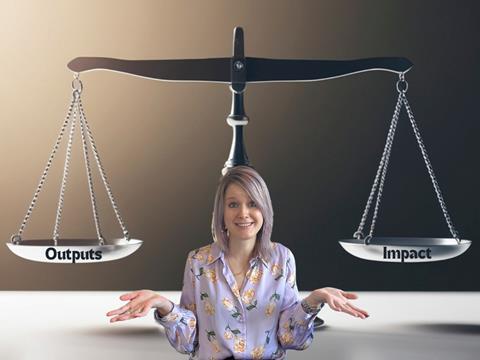
As AI tools flood the academic system with manuscripts, the publishing world is under growing pressure. Isabelle Kohler argues that academia has drifted from asking why we do research to measuring how much we produce – and calls on researchers to shift their focus from outputs to genuine scientific and societal impact.
For the past few months, my LinkedIn feed has been dominated by a recurring theme: ‘the publishing system is broken.’ People feeling desperate after an endless reviewing process (up to a year!), researchers refusing to peer-review papers for free, a huge increase in submissions since the emergence of AI tools, insane profits made by publishing companies, manuscripts being peer-reviewed by AI… The list goes on. But behind all this noise, I think a more fundamental question is being raised: what is the actual purpose of publishing?
When I was a PhD student, I thought that publishing a scientific article was a major aim of my work – it would bring my research to the world, and signal my quality as a researcher. Rejected papers always felt hard. Accepted papers just made my day. I know this feeling is shared by the large majority of PhD students, also because an accepted manuscript means getting closer to a completed thesis.
This feeling has evolved over the last few years, especially since the emergence of generative AI. With AI tools accelerating writing and editing, producing a manuscript has never been easier — and the system is now overwhelmed. Researchers already didn’t have enough time to keep up with the literature; this has simply become impossible. The result is a strange loop: AI generates manuscripts that are ‘peer’-reviewed by AI and read by AI. This makes me wonder whether we have slowly shifted our focus from why we do research to how much we produce.
And this is where I think the real problem lies: we tend to confuse output with impact.
In academia, output is easy to define: a scientific article, a thesis, a grant proposal. They are tangible, measurable, and fit neatly into the evaluation systems. But impact is harder to capture. Impact is what happens after publication – when someone uses your method, when your findings lead to a new clinical test, or when your results shape policies outside of academia. Output is immediate and visible. Impact is slower, sometimes invisible – at least at first.
The current academic system strongly rewards output. PhD students often need a specific number of publications or submitted manuscripts to complete their PhD. Hiring committees look carefully at publication lists. Grant reviewers evaluate applicants based on their track records. Although many funding schemes put emphasis on impact (e.g. the impact section of the NWO VIDI counts for 20% of the total evaluation), output remains the dominant currency.
Yet publications are vehicles for knowledge – not the purpose of knowledge itself. So how do we shift our mindset from ‘how many papers do I need to publish?’ to ‘what difference can I make with my work?’. We can’t control the evaluation system, but we can control how we approach our work within it.
Here are a few suggestions to move from a focus on output to creating more impact:
- Start with the problem, not the paper. When designing a study, ask yourself who would genuinely care about the answer and what would change if your findings are confirmed. Impact usually begins with relevance – define it clearly from the start.
- Think about usability. A brilliant method that is impossible to reproduce will rarely travel far. Clean datasets, transparent protocols, accessible code, and clear writing make it easier for others to build on your work.
- Look beyond your academic circle. Present your work to people from other disciplines, and if relevant, talk to practitioners, industry partners, or policymakers. Such conversations help you understand whether your work resonates outside your field – and will expand your network (win-win!).
- Share your work with the general public. Write posts on social media to communicate your findings – a great exercise in clarity about the relevance of your work. Explaining it to friends and family will keep you honest about its real-world impact.
- Reflect on how you define success for a project. Instead of asking how many papers you can extract from a dataset, ask what the core contribution really is. Sometimes that will naturally lead to multiple publications – sometimes it will push you to invest more time in strengthening one solid piece of work.
The publishing system is certainly under pressure. It may or may not change fundamentally in the coming years. But if publications become a weaker proxy for quality, impact may gradually attract more attention. As researchers, we cannot fully redesign the system. What we can do is pause and reflect on our own projects. When you think about the study you are currently working on, what is its real purpose? Is it primarily to add another line to your CV or to create something that others will use, build upon, or carry forward?
If you are interested in learning more about how to navigate academia and the publishing game, do not hesitate to join the NextMinds Community! For this, you have plenty of choices: visit NextMinds website to learn more about my work, sign up for the newsletter, and follow me and NextMinds on LinkedIn.












Nog geen opmerkingen