



How can we ensure that pesticides used in agriculture are both effective and safe? Ghent-based start-up B-COS hopes to provide part of the solution with chitooligosaccharides, which are produced by bacteria. These carbohydrate-like substances act as a vaccine, boosting the plant’s immune system.
Pesticides are a constant source of concern. Various agents used to protect crops against fungi and insects have now been banned due to health risks, including mancozeb (linked to cancer and birth defects) and chlorpyrifos (linked to changes in brain structure in children). There are also undesirable environmental effects. Pesticides seep into surface and groundwater, affecting ecosystems in ways that are still unclear. Furthermore, the use of such substances can also result in the death of beneficial insects, such as bees.
Although there are friendlier alternatives for crop protection, their production is complicated and difficult to scale up. Moreover, they are not nearly as effective as synthetic pesticides. B-COS, a Ghent University spin-off founded last June, has developed a method of using genetically modified bacteria to produce molecules that protect plants against diseases and pests. CEO and co-founder Chiara Guidi: ‘Last summer, we achieved excellent results with our COS products in fields at certified research organisations.’
Triggering the immune system
COS stands for chitooligosaccharide. These sugar chains are found in the shells of crustaceans, as well as in the cell membranes and walls of insects and fungi. ‘They consist of monomers of N-acetylglucosamine and glucosamine’, explains Wouter Demeester, B-COS’s CTO and co-founder. ‘We produce COS molecules with Escherichia coli bacteria in bioreactors. We have modified them in such a way that they contain a specific number or combination of monomers. This gives us various types of COS products.’
‘Chemical or enzymatic production limits your scalability’
The powder obtained in this way is then applied to crops. ‘There, they trigger the plant’s immune system, which then ‘remembers’ those COS molecules’, says Guidi. ‘So when a pathogen or pest arrives, the plant’s defences are activated. It’s just like a vaccine in humans.’
Economically interesting
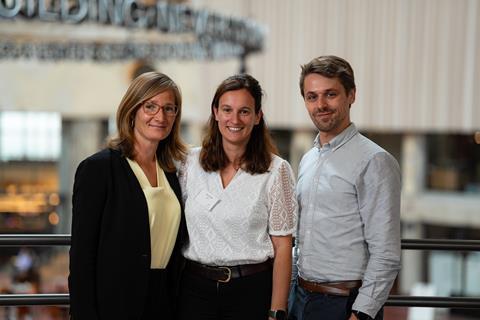
Although the idea of using COS as a plant vaccine is not new, B-COS’s bottom-up approach is. ‘Until now, these molecules were mainly produced chemically or enzymatically’, says Demeester. ‘But that limits scalability and makes it much more difficult to control the composition of the final product. We know that our concept is also really economically interesting for farmers.’ B-COS’s technology is the result of 15 years of research by the Ghent synthetic biology group, led by Marjan De Mey. Guidi and Demeester became involved in the project at the end of the last decade. It soon became clear that this could lead to the creation of a start-up, which was founded together with business developer Maaike Perneel, who is now CCO.
’However, this proved to be somewhat challenging, given that this is a biotech and agritech company’, says Guidi. ‘As if scaling up at the lowest possible cost wasn’t difficult enough, there is also the issue of a limited number of crop cycles per year. You can’t test and validate all year round. Furthermore, the registration process for a new agricultural product is very complicated.’
Guidi and Demeester are now talking to investors and have just been admitted to the Biotope Incubator in Ghent, which is a significant development. ‘We hope to have our first product on the market within a few years’, explains Guidi. ‘It will be a COS that stimulates plant growth during periods of drought and stress. We are focusing on the Benelux countries, as well as Southern Europe, where the effects of climate change on agriculture are already clearly visible.’
‘As soon as a pathogen or pest appears, the plant’s defences are activated’
However, more field trials need to be conducted with the COS products first, says Guidi. ‘So far, the tests have only covered a maximum of 100 square metres of the area we treated. The next step is to expand this to several hectares.’ Production also needs to be scaled up. A pilot project has been initiated to produce around 150 litres per bioreactor tank, but the ultimate goal is to reach 75,000 litres. Demeester: ‘We are also looking at improving the formulation and want to determine exactly how much powder needs to be applied to the land for an optimal effect.’
B-COS’s mission is to protect crops naturally. However, according to Guidi, this does not mean that synthetic pesticides can be completely replaced by COS. ‘They also work very well. We see our product more as something that can be used alongside traditional pesticides and other biopesticides. This means that less toxic substances are needed overall. This allows you to work both preventatively and when the disease or pest is already present. We hope that, in this way, we can become part of the future of agriculture.’
The start-up section is made possible by Pivot Park Oss
Accelerating in biopharma: starting out at Pivot Park
For entrepreneurs starting in the biopharmaceutical sector, the Pivot Incubator program offers the perfect springboard. Start-ups gain access to fully equipped labs, flexible office space, and a starter package with essential equipment. In addition, there is personalized guidance, access to experienced mentors, and a powerful network of experts and investors.
Community events and knowledge sharing encourage collaboration and growth from day one.
Interested in launching your initiative at Pivot Park? We would be happy to explore how Pivot Incubator can add value.
Pivot Park in Oss is the hotspot for companies and knowledge institutions in the biopharmaceutical industry. On this campus, more than 1,000 professionals work at some 65 start-ups, scale-ups, and established companies. Pivot Park is more than just a location: it is an ecosystem where innovation and entrepreneurship come together. A place where the healthcare of tomorrow is being built.










Nog geen opmerkingen