


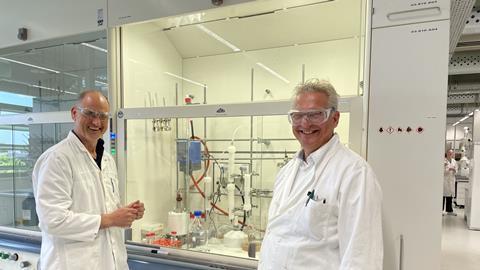
Matrigel, which is based on tumour tissue from mice, is currently the undisputed leader in the cell culture media market. However, the Nijmegen-based start-up SBMatrices is causing a stir with its fully synthetic, animal-free gel, Fybrix, which provides an equally good environment for cells and delivers consistent results.
‘At the moment, we are actually growing our cells on anabolic steroids’, says Paul Kouwer, founder and chief technology officer of SBMatrices, who is also an associate professor of synthetic organic chemistry at Radboud University. He is referring to Matrigel, which is currently the gold standard for 3D cell growth in a market worth €1.5 billion annually.
However, it is not ideal. Matrigel consists of a basement membrane matrix extracted from mouse sarcomas. ‘So you’re dealing with a tumour environment that greatly stimulates cell growth’, explains Kouwer. ‘That’s great if you don’t want to wait weeks for your target cells, but it doesn’t mimic a normal bodily environment.’
And that’s not the only drawback. Not only is culturing from mouse tumours not exactly animal-friendly or sustainable, but the variation per mouse and therefore per batch can also be enormous. ‘So you have to calibrate constantly to obtain reliable results. Last but not least, you can’t grow an organoid in a mouse tumour and then implant it in humans.’
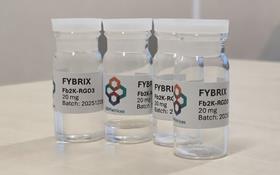
This highlights the need for an alternative cell growth material, which SBMatrices now offers in the form of a fully synthetic hydrogel that is also very user-friendly. ‘You put your cells in the polyisocyanide (PIC) solution at a low temperature’, Kouwer explains. ‘Then you heat the mixture and it instantly turns into a gel. If you want to remove your cells after a while, simply cool the whole thing back down to 5 °C and the gel will disappear.’
Glycol esters
This unusual method of gel formation was discovered in 2009 from a completely different angle. ‘That was during a project in which we were trying to apply electro-optically active polyisocyanides to security papers’, says Kouwer. ‘To do this, we needed to get the polymers into water, but that didn’t work very well. Postdoc Mathieu Koepf suggested adding glycol esters. Suddenly, this special hydrogel appeared.’
Kouwer, Koepf and their colleagues then decided to investigate the substance and its remarkable physical and chemical properties further. This resulted in a publication in Nature in 2013. ‘Our PIC gel turned out to be the first synthetic material discovered to behave in this way.’
Years later, Kouwer realised that the material was ideal for cell growth. ‘We spoke with cell biologists and discovered the disadvantages of Matrigel. That’s when I realised that our PIC gel could make a difference for in vitro disease models, cancer research and drug screening.’
Organoids
Thanks to successful in vitro results, the team received more and more requests for samples from fellow researchers. Kouwer: ‘At that point I thought: I could keep asking a PhD student to make a sample for the umpteenth time, but that would, of course, cost them time and energy. If we are serious about replacing Matrigel as the matrix for 3D cell growth, we need to start doing that from the beginning.’
No sooner said than done. Kouwer sought the help of business expert Sander Claus. ‘Through OostNL, which supports start-up entrepreneurs in Gelderland and Overijssel, I was introduced to Paul’, says Claus. ‘I was inspired by his story, and together, we founded SBMatrices in November 2024.’ The most important PIC gel, Fybrix, has now been validated in many laboratories.
One of these gels is used by Hans Clevers, a molecular geneticist and cancer researcher at the Hubrecht Institute in Utrecht (see also C2W | Mens & Molecule 9, 2025). Clevers is considered the founder of organoid technology. ‘We have placed certain bacterial proteins from his laboratory on the PICs’, says Kouwer. ‘As a result, the cells grow in the gel but do not differentiate, thus remaining in good condition for organoid formation. We are receiving excellent feedback about this.’
Consistent and scalable
Fybrix can be specifically tailored to different studies and is consistent and scalable, explains Kouwer. ‘For liver cells, for example, you need strong collagen signals. So, rather than supplying a one-size-fits-all gel, we provide a platform that grows with the application.’
The product is ready for commercial launch, but this will take some time. The team is currently finalising the necessary licences. According to Claus, it seems certain that SBMatrices has a bright future ahead of it. ‘Research into regenerative and personalised medicine is currently growing explosively. Demand for reproducible, animal-free 3D cell culture solutions is increasing rapidly. So the potential is enormous.’
It is also exciting, he continues. ‘We are currently a team of three and are still a small player. SBMatrices has to compete with major producers of Matrigel. But that is precisely where our opportunity lies. Fybrix offers something that they cannot provide, but which is in demand: a fully synthetic, consistent, and scalable solution for 3D cell growth and organoids. We are convinced that this can become the new gold standard, and that we will capture a significant share of the market.’
The start-up section is made possible by Pivot Park Oss
Accelerating in biopharma: starting out at Pivot Park
For entrepreneurs starting in the biopharmaceutical sector, the Pivot Incubator program offers the perfect springboard. Start-ups gain access to fully equipped labs, flexible office space, and a starter package with essential equipment. In addition, there is personalized guidance, access to experienced mentors, and a powerful network of experts and investors.
Community events and knowledge sharing encourage collaboration and growth from day one.
Interested in launching your initiative at Pivot Park? We would be happy to explore how Pivot Incubator can add value.
Pivot Park in Oss is the hotspot for companies and knowledge institutions in the biopharmaceutical industry. On this campus, more than 1,000 professionals work at some 65 start-ups, scale-ups, and established companies. Pivot Park is more than just a location: it is an ecosystem where innovation and entrepreneurship come together. A place where the healthcare of tomorrow is being built.








Nog geen opmerkingen