


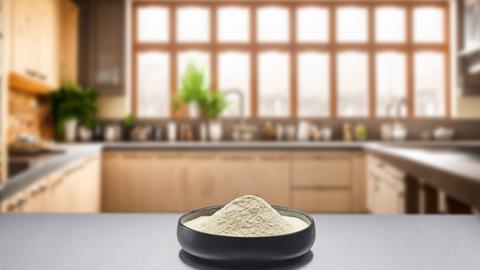
Fermentation has a positive ecological footprint. Dutch start-up The Protein Brewery uses this process to ‘brew’ a fungus that is a highly nutritious, complete source of protein. ‘We are becoming more aware that animal proteins alone are insufficient.’
‘Virtually all elements of our fungus are highly nutritious and useful’, says Gilbert Verschelling, CTO of The Protein Brewery. ‘It contains not only proteins and fibres, but also vitamins, minerals, and other healthy substances. In short, it is a very complete source of nutrition.’ This is good news because the world’s population is still growing rapidly. By 2037, there will probably be 9 billion people on Earth, and another billion by 2057. ‘The demand for food is therefore high, and we are becoming increasingly aware that animal proteins alone are not enough’, says Verschelling. Of course, plant-based proteins are an alternative. However, according to The Protein Brewery, fungi can also make a valuable contribution.
Survival of the fittest
The Breda-based start-up produces Fermotein®. ‘It consists of the entire fungal biomass’, explains Ap de Haan, Plant Improvement Manager and The Protein Brewery’s first employee. ‘But dried and ground.’ This fungus, Rhizomucor pusillus, is a natural extremophile. ‘We selected it using a rigorous method to ensure it thrives under certain conditions, such as high temperature and pH, where all its competitors die. Here, survival of the fittest applies.’
As no other microorganisms can survive under these conditions, the fermentation process is relatively simple. This significantly reduces costs and results in much lower CO2 emissions and water consumption. Verschelling: ‘This definitely helps us adapt to the market well and has a positive, sustainable impact on the world.’ The fungus needs ammonia as a nitrogen source and glucose syrup from wheat as a carbon source, for example, and then grows rapidly, De Haan explains. ‘If this basic process works well enough, we will move on to developing more complex carbon sources, such as starch from potatoes or cassava. In the long term, we also want to utilise residual flows from food production.’ After harvesting, the biomass is dehydrated and pasteurised. ‘This kills the fungus. Then it’s just a matter of drying and grinding’, says De Haan.
’In the long term, we also want to add value to residual flows from food production.’
Ap de Haan
The Protein Brewery is a spin-off of the contract research company BioScienZ. ‘That company develops and optimises fermentation processes and is led by Wim de Laat’, says De Haan. ‘He is an inexhaustible source of ideas and, at the end of the last decade, he came up with the idea of using an extremophilic fungus for fermentation. I was involved from the outset.’
Fish Feed
Initially, the two focused on making fish feed. ‘Then a major player in the meat substitute industry asked us if we could make food for humans that was much better, because the fungus turned out to be such a high-quality source of protein.’ No sooner said than done. An extensive screening process began. ‘We wanted a fungus with the most complete amino acid profile possible’, explains De Haan. ‘And the harvested biomass had to be colourless, odourless and tasteless, because adding masking agents is expensive.’
Once the fungus had been selected and The Protein Brewery became a reality in January 2020, the process of developing and scaling up began. This culminated in the establishment of a pilot plant in June 2021, followed by the opening of the first commercial production facility in Breda in January of the following year. ‘There are now two 90,000-litre fermenters there’, says Verschelling. ‘But we already have plans, made possible in part by a recent Series B investment of €30 million, to move towards a factory that is 20 to 30 times larger within a few years. This will enable us to increase production of Fermotein® from hundreds to thousands of tonnes per year. That will enable us to make a serious impact.’
‘Unfortunately, it all takes a little longer in Europe.’
Gilbert Verschelling
Meal bar
They are thinking broadly in terms of applications. ‘For example, processing the mould powder into a biscuit, dairy alternative, nutritional drink or healthy meal bar’, says Verschelling. ‘We have already received approval for the production and sale of a number of products in the United States and Singapore. Unfortunately, it’s taking a little longer in Europe, but we expect approval there soon as well.’ In the meantime, there are still plenty of plans to improve the production technology, De Haan points out. ‘No fermentation plant has reached the final stage of the process when it first goes into operation. I think that’s also the charm of this field: there’s always room for improvement.’
‘We’ll be busy for a while yet’, adds Verschelling. ‘How can we make it simpler and cheaper? What other applications are there? We are constantly discovering new and interesting things about our fungus. For instance, we recently found out that it contains certain bioactive substances that could be used in food products designed to promote healthy ageing. We are currently working on a related project.’ The team at The Protein Brewery hopes that Fermotein® will have a serious impact on the world. ‘The food of the future should be sustainable, healthy, and simply delicious’, says Verschelling. ‘And we believe we can help provide that. It’s the dot on the horizon that we continue to focus on.’
The start-up section is made possible by Pivot Park Oss
Accelerating in biopharma: starting out at Pivot Park
For entrepreneurs starting in the biopharmaceutical sector, the Pivot Incubator program offers the perfect springboard. Start-ups gain access to fully equipped labs, flexible office space, and a starter package with essential equipment. In addition, there is personalized guidance, access to experienced mentors, and a powerful network of experts and investors.
Community events and knowledge sharing encourage collaboration and growth from day one.
Interested in launching your initiative at Pivot Park? We would be happy to explore how Pivot Incubator can add value.
Pivot Park in Oss is the hotspot for companies and knowledge institutions in the biopharmaceutical industry. On this campus, more than 1,000 professionals work at some 65 start-ups, scale-ups, and established companies. Pivot Park is more than just a location: it is an ecosystem where innovation and entrepreneurship come together. A place where the healthcare of tomorrow is being built.







Nog geen opmerkingen