


With 3D printers, you can create advanced, custom-made equipment at an affordable price. This is not only achieved by printing parts and components entirely to your own specifications, but also by converting the printer itself into a lab robot. ‘In the past, researchers used to build the equipment for their experiments themselves.’
Need to quickly replace a broken hook or create a trendy gadget? A 3D printer has you covered. There are countless DIY 3D printer models available for laboratory use, ranging from coasters to sensors and molecular models. One of the most popular models is the ultimate laboratory bench organiser by Vittorio Saggiomo, an associate professor in the BioNanoTechnology group at Wageningen UR. This modular storage aid is ideal for organising small laboratory items such as pipettes, spatulas and cuvettes.
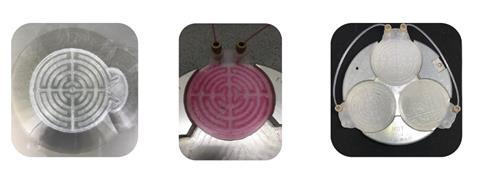
However, for Saggiomo, this ‘hobby printing’ is merely the starting point. In his research group, 3D printers are used to design and produce the equipment needed for experiments. ‘These are often items that are not commercially available or difficult to obtain’, he explains. This problem arises in various fields of research, including microfluidics. Saggiomo has developed a clever technology for producing microchannels using a 3D printer: Embedded SCAffold RemovinG Open Technology (ESCARGOT). The ‘sacrificial material’ for the channels is printed in ABS. These thin filaments are then cast in PDMS (polydimethylsiloxane). As ABS dissolves in acetone, the ‘sacrificial material’ can easily be removed, leaving a microchannel.
’We have lost a great deal of practical knowledge about equipment over the past few decades.’
Vittorio Saggiomo, Wageningen UR
Costs
Stephen Hilton, Professor of Chemistry and Enabling Technologies at University College London, also uses 3D printers to build expensive equipment. His lab uses flow chemistry for synthesising complex molecules, but commercial flow reactors are very expensive. Hilton: ‘If a reaction failed, the reactor would block and become unusable. That would always cost around £2,000 [over €2,300]. By 3D-printing the reactor core ourselves, however, we were able to reduce the cost to 50 pence [€0.57] and our research is no longer limited by cost.’
‘By 3D-printing the reactor core ourselves, we were able to reduce costs from £2,000 to 50 pence’
Stephen Hilton, University College London
Hilton demonstrates that there is much more potential with 3D printers. For example, his group developed stirrers with an integrated catalyst. ‘By introducing a catalyst into the reaction mixture during the polymerisation reaction, the catalyst becomes embedded in the polymer. We use this material to print various types of stirrers fitted with different metal catalysts.’ In the Hilton lab, 3D printers have become indispensable; they currently have 35 of them.
Injection robot
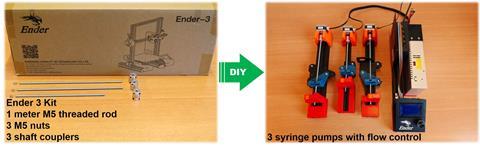
Saggiomo goes one step further. He ‘hacks’ 3D printers. ‘These days, you can get a 3D printer for around 150 euros. You’re essentially holding a very cheap robot in your hands.’ The first steps in this ingenious ‘repurposing’ of 3D printers were taken during the pandemic. ‘I was working from home and wanted to build an injection pump. The 3D printer I had was perfect for this purpose. Our group first used it to print all the parts, and then converted it into an injection robot.’
Since then, Saggiomo and other laboratories have built various devices based on 3D printers, including microscopes and an automated microscope slide stainer for histological purposes. He would like to see 3D printers used more widely in university laboratories, as this would boost students’ inventiveness: ‘Every student should have access to a prototyping lab with 3D printing facilities, laser cutters, and CNC machines. We have lost a great deal of practical knowledge about equipment over the past few decades. Researchers used to build the equipment they used for their experiments themselves. Now we buy devices without knowing how they work.’
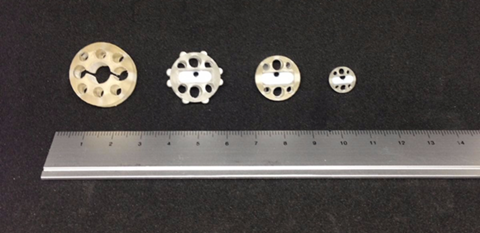
Image: HILTON GROUP
Injection moulding
Although 3D printers present no limitations for these two creative scientists, industrial laboratories mainly work with standardised materials produced by injection moulding. ‘When it comes to truly accurate, dimensionally stable parts, 3D printers often fail to deliver the required precision’, says Michael Greiner, Head of Research & Development at Bürkle, a German laboratory equipment manufacturer. He also believes that mechanical strength is less controllable. ‘In fused deposition modelling, plastic filaments are laid on top of one another and fused together. Depending on the print orientation and the position of the layers, a model may break more easily in one direction than another. This can lead to premature failure in mechanically stressed components.’
Furthermore, certifying 3D-printed products for use in the food industry or cleanrooms is complex. The entire process chain must be strictly monitored. Although food-safe filaments exist, the 3D printing process is not designed for these applications. Nozzles are often made of brass and may contain lead. Standard lubricants are not suitable for food contact. Injection-moulded products are smoother and easier to control microbiologically; for example, during sterilisation with gamma radiation.
‘When it comes to producing accurate, dimensionally stable parts, 3D printers often do not deliver the required precision.’
Michael Greiner, Bürkle
Chemical resistance poses an additional challenge. Commonly used filaments such as PLA, PETG and ABS dissolve in chlorinated solvents or acetone respectively. For applications requiring chemical resistance, materials such as polypropylene (PP) or polyvinylidene fluoride (PVDF) are therefore used. These materials can be printed using newer printers, but at a higher cost. Moreover, for larger quantities, the injection moulding process is much cheaper.
Bürkle uses 3D printing primarily for internal purposes, explains Greiner. ‘We print parts for testing purposes and prototypes of potential new products. The printed prototypes are ideal for getting something in your hands quickly, assessing the dimensions and feel, and carrying out initial functional tests.’ Hilton agrees, saying, ‘You shouldn’t 3D-print pipette tips; it’s not cost-effective. But for new items with a production run of 200–300, it’s certainly of interest to companies too.’









Nog geen opmerkingen